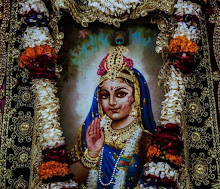
Imagem: Kiśorī Rādhā por Vṛndāvana Dāsa. Nossa amada Svāmini Rādhā com Seu Sārī azul escuro (para recordar Kṛṣṇa) e Seu Colī vermelho (que indica Sua paixão por Kṛṣṇa), na exuberante e deslumbrante floresta de Vṛndāvana !!!
Entre vários conceitos errados que envolvem Rāgānugā-bhakti, um deles é que, como o Siddha-deha só é realmente realizado em Bhāva, cria-se a noção errada de que a meditação no mesmo só começa a partir daí.
Mas a realização em Bhāva só acontece porque houve uma meditação e cultivo anteriores.
De facto, Bhāva só é alcançada se houver este cultivo em etapas anteriores, caso contrário não se alcança nada.
O praticante alcança no final o que cultivou anteriormente.
Existem três corpos Siddha:
1 - Siddha deha - o cultivo ou o corpo almejado.
2 - Svarūpa-siddhi - a realização do Siddha-deha em Bhāva.
3 - Vastu-siddhi - a realização final do Siddha-deha em Prema.
Isto é confirmado por todos os Ācāryas que respondem em coro:
====================
1 - SIDDHA-DEHA - Niṣṭhā, Ruci, Āsakti
====================
Śrīla Rūpa Gosvāmī
Bhakti-rasāmṛta-sindhu (1.2.295):
sevā sādhaka-rūpeṇa
siddha-rūpeṇa cātra hi
tad-bhāva-lipsunā kāryā
vraja-lokānusārataḥ
"Ao seguir os habitantes de Vraja, deve-se prestar serviço com seu corpo físico e com seu corpo Siddha, com o desejo por um Bhāva específico."
O significado da forma Sādhaka é evidente, isto significa o corpo físico actual. No entanto, o conceito da forma Siddha merece uma análise mais aprofundada. Como é que se pode servir numa forma Siddha, se a pessoa não atingiu a perfeição (Siddhi)?
Afinal, o devoto(a) Siddha é aquele que alcançou Prema, e este verso aparece numa secção que descreve Sādhana-bhakti. Não é isto um oxímoro?
Pois, isto é assim porque o Siddha-deha é um corpo almejado e cultivado. Ainda não foi obtido. É exactamente isto, almejado na fase de Sādhana.
====================
Para este verso, os comentadores (Śrīla Jīva Gosvāmī, Śrīla Mukunda Gosvāmī e Śrīla Viśvanātha Cakravartī Ṭhākura) respondem todos a mesma coisa:
siddha-rūpeṇa antaś-cintitābhīṣṭa-tat-sevopayogi-dehena ||
"A forma Siddha significa uma forma internamente pensada e desejada, um corpo interno adequado para o Seu serviço."
Aqui, a palavra "abhīṣṭa", "desejada", revela que estamos a falar de algo que ainda está para ser alcançado. É almejado.
====================
Śrīla Jīva Gosvāmī:
Śrīla Jīva Gosvāmī:
tatra bhūta-śuddhir nijābhilaṣita bhagavat sevaupayika tat pārṣada-deha bhāvanā paryantaiva tat sevaika puruṣārthibhiḥ kāryā nijānukūlyāt (Bhakti Sandarbhaḥ – 286):
"Aqui é explicado o bhūta śuddhih dos devotos. Isto significa pensar no próprio corpo espiritual desejado, com o qual se associa com o Senhor e que é adequado para servi-Lo. O verdadeiro bhūta śuddhi para um devoto é pensar em si mesmo em seu próprio siddha svarūpa. Esta forma de pensar é favorável para aqueles que sabem que o objectivo mais elevado da vida é servir a Deus."
====================
Kṛṣṇadāsa Kavirāja no Caitanya Caritāmṛta Madhya 22.108.155-6:
mane (mente) nija (seu) siddha-deha kariyā bhāvana (pensando em), pense em seu siddha deha como um sādhana, ei ta sādhana bhakti.
====================
Śrīla Narottama Dāsa Ṭhākura
O conceito é evidenciado por Śrīla Narottama Dāsa Ṭhākura no seu Prema-bhakti-candrikā 55:
sādhana bhāvibo yāhā, siddha-dehe pābo tāhā |
rāga pathera ei se upāya ||
"Seja qual for o humor do Siddha-deha que se almeje durante o Sādhana é o que se alcança no estágio perfeito. Este é o método para aqueles no caminho de Rāgānugā-bhakti."
====================
No Bṛhad-bhāgavatāmṛta, de Sanātana Gosvāmī, quando Nārada Muni instrui Gopa-kumāra, aprendemos sobre a meditação no siddha-deha durante o sādhana:
"Na sua meditação interna, o sādhaka serve os pés de lótus de Śrī Kṛṣṇa numa rasa específica, com uma forma, vestuário e assim por diante que sejam adequados ao seu serviço.
Ao atingir a perfeição no final da sua vida, entra em Vaikuṇṭha. Nesse momento, o seu coração é atraído por aquela rasa anterior em que, enquanto estava no estágio de sādhaka, adorava o Senhor, e aceita uma indumentária e forma idênticas, sabendo que são queridas por Śrī Bhagavān."
(BB 2.4.145-146)
====================
Śrīla Kṛṣṇadāsa Kavirāja Gosvāmī
Ao cantar o Santo Nome, o Sādhaka desenvolve desejos espirituais de serviço e, assim, "cria, fabrica e constrói" (Parikalpya) seu próprio Siddha-deha no qual medita.
Em seu Sāraṅga Raṅgadā-ṭīkā do Kṛṣṇa Karṇāmṛta (de Śrī Bilvamaṅgala Ṭhākura) (2), Śrīla Kṛṣṇadāsa Kavirāja Gosvāmī (que é Vaiṣṇava Gauḍīyā) diz:
rāgānugā mārge anutpanna rati sādhaka bhaktair api svepsita siddha dehaṁ manasi parikalpya
"No caminho de Rāgānugā, mesmo um Sādhaka Bhakta que ainda não tem Rati pode pensar e meditar em seu próprio Siddha-deha desejado e criado."
Então ele continua:
jāta ratīnāṁ tu svayam eva tad deha sphūrteḥ
“Quando Rati surgir, este corpo será automaticamente revelado.”
Aqui a palavra Parikalpya é extremamente importante. Parikalpya significa o Siddha-deha construído, fabricado, criado pelo próprio Sādhaka. Almejado.
E assim, o Sādhaka pensa e medita nos 11 (Ekādaśa) aspectos do seu Siddha-deha.
====================
O comentário:
O comentário:
अथास्य तद्वेश्यावक्त्राच्छ्रीराधायाः श्रीकृष्णानुरागादिश्रवणजातलोभत्वाद्रागानुगामार्गेणैव भजनम् । तत्र रागानुगामार्गेऽनुत्पन्नरतिसाधकभक्तैरपि स्वेप्सितसिद्धदेहं मनसि परिकल्प्य भगवत्सेवादिकं क्रियते । जातरतीनां तु स्वयमेव तद्देहस्फूर्तिः । अस्य तूत्पन्ना मधुरजातीया रतिः क्रमेणानुरागदशां प्राप्तास्ति, अतस्तद्देहस्फूर्तिः सदैव ।
athāsya tad-veśyā-vaktrāc chrī-rādhāyāḥ śrī-kṛṣṇānurāgādi-śravaṇa-jāta-lobhatvād rāgānugā-mārgeṇaiva bhajanam | tatra rāgānugā-mārge’nutpanna-rati-sādhaka-bhaktair api svepsita-siddha-dehaṁ manasi parikalpya bhagavat-sevādikaṁ kriyate | jāta-ratīnāṁ tu svayam eva tad-deha-sphūrtiḥ | asya tūtpannā madhura-jātīyā ratiḥ krameṇānurāga-daśāṁ prāptāsti, atas tad-deha-sphūrtiḥ sadaiva |
(Sāraṅga Raṅgadā-ṭīkā do Kṛṣṇa-karṇāmṛta: 2)
"Seu bhajana [ou seja de Bilvamaṅgala Ṭhākura] foi baseado exclusivamente em rāgānugā-mārga por causa de seu intenso desejo (lobhatva) produzido ao ouvir sobre o anurāga de Śrī Rādhā e assim por diante para Śrī Kṛṣṇa da boca da cortesã [ou seja, Cintāmaṇi]. Em rāgānugā-mārga, mesmo para os sādhaka-bhaktas nos quais rati [ainda] não se manifestou, o serviço e assim por diante a Bhagavān é realizado meditando na mente sobre o siddha-deha desejado. Para aqueles em quem rati se manifestou, entretanto, a manifestação (sphūrti) daquele deha [ou seja, o siddha-deha] ocorre por si só [ou seja, sem exigir qualquer esforço específico do sādhaka para meditar sobre ele]. Seu [de Bilvamangala Ṭhākura] rati manifesto do tipo madhura, entretanto, gradualmente atingiu o estágio de anurāga [mesmo que isto normalmente seja impossível para qualquer pessoa dentro do saṁsāra, excpeto aqueles que participam directamente da prakaṭa-līlā de Bhagavān], e assim a manifestação deste deha [ou seja, o siddha-deha] tornou-se constante [em sua mente]."
====================
Śrīla Bhaktivinoda Ṭhākura
No Hari-nāma Cintāmaṇi, Śrīla Bhaktivinoda Ṭhākura explica em 15.93 que o Sādhaka medita no Siddha-deha como Smaraṇa inicial em Niṣṭhā e medita no Siddha-deha em Samādhi quando alcança Svarūpa-siddhi em Bhāva.
Śrīla Bhaktivinoda Ṭhākura explica que a lembrança (Smaraṇa) do Siddha-deha na fase inicial é inconsistente e imperfeita. Às vezes podemos lembrar e às vezes há distracção.
Ele explica que a meditação no Siddha-deha vai se tornando mais intensa com a progressão por Smaraṇa, depois Dhāraṇā, depois Dhyāna, depois Anusmṛti e no final Samādhi.
====================
Śrīla Bhaktisiddhānta Sarasvatī Ṭhākura
"Aqueles que cantam os Santos Nomes purificam os Anarthas. Ao fazer isto, eles devem cantar os Santos Nomes de acordo com o gosto do seu relacionamento pessoal (Rasa) com o Senhor (no estágio de Sādhana-bhakti).
Depois, desta forma, eles alcançarão o estágio de Bhāva-bhakti, o estágio preliminar do amor a Deus, que também é chamado de Rati permanente."
(Amṛta Vāṇī - Śrīla Bhaktisiddhānta Sarasvatī Gosvāmī Mahārāja)
====================
Śrīla A.C. Bhaktivedānta Svāmī Prabhupāda
"Discípulo: Então Śrīla Prabhupāda, um devoto neófito, ele pode pensar que poderia ser muito bom ser um amigo de Kṛṣṇa, mas ele poderá realmente ser uma folha de grama e ele estará totalmente satisfeito quando chegar a este estágio?
Śrīla Prabhupāda: Não. Mas quando, no momento do serviço devocional, se tal ímpeto vem, isto significa que ele tem esta relação. E ele deve desenvolvê-la. Isto é tudo. Isto significa que a relação real com Kṛṣṇa está surgindo gradualmente. Está sendo desenvolvida. Então, é preciso desenvolvê-la, seguindo os passos dos amigos de Kṛṣṇa em Vṛndāvana. Isto é descrito aqui."
(Palestra Śrīmad-Bhāgavatam 6.3.16-17, Gorakhpur, 18 de Fevereiro de 1971)
Estão todos os Ācāryas estão em sintonia !!! Muito claro !!!
====================
Também:
"Uma lagarta confinada em um buraco de um muro por uma vespa sempre pensa na vespa com medo e inimizade e mais tarde se torna uma vespa simplesmente por causa de tal lembrança."
(SB 7.1.28-29)
O Sādhaka alcançará o corpo no qual medita durante o Sādhana.
Se não medita em nada, não alcança nada.
Existe uma espécie de vespa (as vespas pertencem a mesma classificação das abelhas) que coloca seus ovos numa lagarta.
====================
2 - SVARŪPA-SIDDHI - a realização do Siddha-deha almejado que ocorre em Bhāva e nos estágios iniciais de Prema.
Esta é a forma e identidade espiritual plenamente realizada para a participação directa em Aṣṭa-kālīya-līlā através da meditação em Samādhi, enquanto a pessoa ainda está dentro dos corpos físico e subtil.
Quando alguém alcança Bhāva, esta forma espiritual é concedida directamente por Kṛṣṇa exactamente de acordo com os desejos e preferências do praticante, previamente cultivados quando meditava em seu Siddha-deha durante Rāgānugā-sādhana-bhakti.
====================
3 - VASTU-SIDDHI - Prema em Bhauma-līlā e Aprakaṭa-līlā
Quando estivermos completamente livres dos corpos materiais físico e subtil, nasceremos de uma Nitya-siddha Vraja Gopī e, neste corpo e identidade transcendentais, nos ocuparemos directamente nos passatempos eternos manifestos de Kṛṣṇa (Prakaṭa-nitya-līlā) em um planeta terrestre.
Depois que nosso Prema é totalmente aperfeiçoado ali, somos transferidos para os eternos e imanifestos passatempos (Aprakaṭa-nitya-līlā) no Mundo espiritual com o corpo eterno final.
====================
Esta é a ordem de como as coisas funcionam !!!
====================
SIDDHA‑DEHA
nāma rūpaṁ vayo veśa sambandho yūthā eva ca |
ajñā sevā parakāṣṭhā pālyā‑dāsī nivāsakaḥ || 93 ||
(Śrī Gaura‑Govindārcana Smaraṇa‑paddhati – Śrīpāda Dhyanacandra Gosvāmī)
“O nome, a forma, a idade, o vestuário,
a relação, o grupo, as ordens recebidas, o serviço, o auge desse serviço, a condição de Dāsī protegida e o lugar de residência.”
Portanto, os 11 elementos (Ekādaśa‑bhāva) são:
1 - nāma – nome
2 - rūpa – forma
3 - vayaḥ – idade
4 - veśa – vestuário
5 - sambandha – relação (vínculo, posição relacional)
6 - yūtha – grupo, séquito, (como o grupo de Lalitā, Viśākhā etc.)
7 - ajñā – ordens recebidas
8 - sevā – serviço
9 - parakāṣṭhā – auge/perfeição desse serviço
10 - pālyā‑dāsī – condição de serva protegida, criada sob tutela
11 - nivāsaka – local de residência
Isto é o siddha‑deha. O siddha‑deha tem 11 (Ekādaśa) elementos (bhāva).
Por exemplo:
O sādhaka (meu caso) medita:
"Eu sou Rangana Mañjarī, a minha forma tem uma cor dourada suave, tenho 12 anos e 5 meses, meu sārī é vermelho suave com borda colorida, sou serva do Casal Divino e minha relação com Kṛṣṇa é conjugal através de Svāminī Rādhā que é tudo para mim, meu grupo é o de Lalitā e sigo suas ordens, meu serviço eterno é fazer arranjos florais, minha única ambição é servir o Casal Divino com as outras Sakhīs, minha guia é Rūpa Mañjarī e sou vāma‑madhya como ela, eu nasci em Vārṣāṇā e casei na aldeia de Yāvat. Mas todas as noites fujo para o Rādhā‑kuṇḍa e lá resido no Puṣpa‑sukhada‑kuñja na parte norte do kuñja de Lalitā Sakhī. Ao pé do Rupollāsa‑kuñja (Rūpa Mañjarī)."
Isto é a meditação no siddha‑deha (corpo mental/espiritual almejado).
====================
MĀNASI‑SEVĀ
Agora mānasi‑sevā é o serviço mental que é feito com este siddha‑deha.
Por exemplo, mentalmente medito:
"Eu, como Rangana Mañjarī, estou a massajar os pés de Svāminī Rādhā a pedido de Rūpa Mañjarī e Lalitā Sakhī."
Isto é mānasi‑sevā com o siddha‑deha.
O Vilāpa Kusumāñjali de Śrī Raghunātha Dāsa Gosvāmī e o Utkalikā Vallarī de Śrī Rūpa Gosvāmī estão repletos de exemplos de como fazer Mānasi‑sevā em Mañjarī‑bhāva com o Siddha‑deha.
Foi por isso que eles escreveram estes livros. Escreveram para nós. Para usarmos na nossa meditação.
=====================
Após deixar o corpo material, o Sādhaka renasce do ventre de uma Gopī num planeta onde os passatempos de Kṛṣṇa estão a acontecer. Isto pode ocorrer neste universo ou noutro. Esta afirmação encontra-se no Ujjvala-nīlamaṇi, que foi comentado por Viśvanātha Cakravartī Ṭhākura.
O Sādhaka nasce no ventre de uma Gopī num Universo material em Prākṛta-līlā. Passa de bebé para criança e depois jovem Mañjarī. Mas este corpo já não é material.
Quando Prakaṭa-līlā termina no Universo material, este corpo é transferido para Aprakaṭa-līlā. Não existe "morte" para este corpo.
Este nascimento em Prakaṭa-līlā é para poder alcançar os últimos estágios de Prema.
====================
Em relação a nascer em Vārṣāṇā e casar em Yāvaṭ.
O Sādhaka nasce como uma Gopī numa aldeia específica de Vraja. Depois do casamento, passa a residir em casa do sogro. Se a flauta melodiosa de Kṛṣṇa lhe chega aos ouvidos, porém, o fascínio pelo serviço a Rādhā leva a Sādhaka Mañjarī ao Rādhā-kuṇḍa. É aí que ela estabelece a sua morada num Kuñja e Kuṭīra.
====================
No seu livro Prārthanā — Svabhista-lālasa, Canção 4 — Śrī Narottama Dāsa Ṭhākura almeja:
hari hari! āra ki emon daśā hobo kobe
vṛṣabhānu pure āhīrī gopera ghare
tanayā hoiyā janamibo
"Hari! Hari! Quando alcançarei esta condição? Quando nascerei como filha na casa de um vaqueiro na cidade de Vṛṣabhānu (Varṣānā)?"
yāvaṭe āmāra kobe e pāṇi grahaṇa hobe
vasati koribo kobe tāya
sakhīra parama śreṣṭha ye hoy
tāhāra preṣṭha sevana koribo tāra pāya
"Quando me casarei na aldeia de Yāvaṭ e quando poderei viver lá? Quando poderei servir os pés de lótus da mais querida serva (Rūpa Mañjarī) e da melhor das Sakhīs (Lalitā)?"
Obs: este segundo verso é traduzido de forma incorreta e incompleta na Iskcon para fugir do tema de Parakīyā-rasa.
==================
Śrī Rādhā nasce em Vārṣāṇā e casa-se em Yāvaṭ. Rūpa Mañjarī também. Assim, almejo e aspiro nascer em Vārṣāṇā e casar-me em Yāvaṭ.
Da mesma forma como almejamos o serviço, a roupa, a forma, etc., também podemos almejar o nome e local de nascimento.
De qualquer forma devemos confirmar isto com o Guru (ou Dīkṣā, ou Śikṣā, ou Caitya).
Devemos sempre lembrar que existem duas correntes em Siddha-praṇālī.
Uma em que o Guru dá todos os detalhes do Siddha-deha e o discípulo simplesmente aceita.
E outra em que o Guru e discípulo, juntos, determinam todos os detalhes do Siddha-deha.
====================
====================
De qualquer forma, o local de nascimento e casamento, nome do esposo, do pai e da mãe, não são os itens mais importantes na meditação do Siddha-deha. Mas podem ser acrescentados se houver interesse.
=====================
“Os nomes da mãe, do pai e do espôso são determinados da seguinte forma: o nome da mãe deriva da primeira sílaba do nome dado ou confirmado pelo Guru ao Sādhaka. O nome do pai deriva da terceira sílaba e o do espôso, da última.”
(Śrī Gaura-Govindārcana-Smaraṇa-Paddhati Śrīpāda Dhyānacandra Gosvāmī verso 90)
====================
No meu caso: Rangana Mallikā
Minha Mãe (jananī): Rasālinī‑sakhī
Meu Pai (pitā): Nalinātha‑gopa
Meu Espôso (pati): Kāñcana‑gopa
E isto segue exatamente a regra do Paddhati:
1ª sílaba → Ra → Rasālinī
3ª sílaba → na → Nalinātha
última sílaba → kā → Kāñcana
Estes são os nomes para meditar nestas personalidades. Porém, no mundo espiritual, uma mesma personalidade pode ter muitos nomes diferentes.
O que o Paddhati de Dhyānacandra descreve é um método prático de sādhana:
O Guru dá ou confirma ao discípulo o nome principal do Siddha-deha (no caso Rangana Mallikā).
A partir das sílabas desse nome, deriva-se de forma padronizada os nomes da mãe, do pai e do esposo.
Isso serve para fixar na mente, de maneira estável e consistente, a identidade completa do Siddha-deha durante a meditação (Smaraṇa).
Ou seja: o método de derivação é uma convenção técnica do Bhajana-paddhati, não a origem ontológica dessas personalidades.
As personalidades em si são eternas; o método só ajuda o Sādhaka a “lembrar” delas de forma organizada.
Ou seja, o Siddha-deha almejado tem características, mas mais detalhes podem ser adicionados quando da realização final do mesmo.
Ou seja, o Siddha-deha almejado ainda não é o Siddha-deha final, mas serve como instrumento de meditação.
====================
====================
Link: Três Corpos Siddha - Three Siddha Bodies = Comentários/Comments
Link: Śrīla Prabhupāda e/and Rāgānugā-bhakti
Link: Śrīla Prabhupāda e/and Rāgānugā-bhakti
====================
Three Siddha Bodies !!!
Image: Kiśorī Rādhā by Vṛndāvana Dāsa. Our beloved Svāmini Rādhā with Her dark blue Sārī (to remember Kṛṣṇa) and Her red Colī (which indicates Her passion for Kṛṣṇa), in the lush and dazzling forest of Vṛndāvana !!!
Among several misconceptions surrounding Rāgānugā-bhakti, one of them is that, as Siddha-deha is only really realized in Bhāva, the wrong notion is created that meditation on it only begins from there.
But realization in Bhāva only happens because there has been previous meditation and cultivation.
In fact, Bhāva is only achieved if there is this cultivation in previous stages, otherwise nothing is achieved.
The practitioner ultimately achieves what he/she previously cultivated.
There are three Siddha bodies:
1 - Siddha deha - the desired cultivated body.
2 - Svarūpa-siddhi - the realization of Siddha-deha in Bhāva.
3 - Vastu-siddhi - the final realization of Siddha-deha in Prema.
This is confirmed by all the Ācāryas who respond in chorus:
====================
1 - SIDDHA-DEHA - Niṣṭhā, Ruci, Āsakti
====================
Śrīla Rūpa Gosvāmī
Bhakti-rasāmṛta-sindhu (1.2.295):
sevā sādhaka-rūpeṇa
siddha-rūpeṇa cātra hi
tad-bhāva-lipsunā kāryā
vraja-lokānusārataḥ
"When following the inhabitants of Vraja, one should render service with one's physical body and with one's Siddha body, with the desire for a specific Bhāva."
The meaning of the Sādhaka form is clear, this means the actual physical body. However, the concept of the Siddha form deserves further analysis. How can one serve in a Siddha form if one has not attained perfection (Siddhi)?
After all, the Siddha devotee is one who has attained Prema, and this verse appears in a section describing Sādhana-bhakti. Isn't this an oxymoron?
Well, this is so because Siddha-deha is a desired and cultivated body. It has not yet been obtained. This is exactly what we aim for in the Sādhana stage.
====================
To this verse, the commentators (Śrīla Jīva Gosvāmī, Śrīla Mukunda Gosvāmī and Śrīla Viśvanātha Cakravartī Ṭhākura) all respond the same thing:
siddha-rūpeṇa antaś-cintitābhīṣṭa-tat-sevopayogi-dehena ||
"The Siddha form means an internally thought and desired form, an internal body fit for His service."
Here, the word "abhīṣṭa", "desired", reveals that we are talking about something that is yet to be achieved. It is being desired.
====================
Śrīla Jīva Gosvāmī:
Śrīla Jīva Gosvāmī:
tatra bhūta-śuddhir nijābhilaṣita bhagavat sevaupayika tat pārṣada-deha bhāvanā paryantaiva tat sevaika puruṣārthibhiḥ kāryā nijānukūlyāt (Bhakti Sandarbhaḥ – 286):
"Here the bhūta śuddhih of the devotees is explained. This means thinking of one’s own desired spiritual body, in which one associates with the Lord and which is suitable for serving Him. The real bhūta śuddhi for a devotee is to think himself/herself in his/her own siddha svarūpa. This way of thinking is favorable for those who know that the highest goal of life is to serve God.”
====================
Kṛṣṇadāsa Kavirāja in Caitanya Caritāmṛta Madhya 22.108.155-6:
mane (mind) nija (own) siddha-deha kariyā bhāvana (thinking of), think of your own siddha deha as a sādhana, ei ta sādhana bhakti.
====================
Śrīla Narottama Dāsa Ṭhākura
The concept is evidenced by Śrīla Narottama Dāsa Ṭhākura in his Prema-bhakti-candrikā 55:
sādhana bhāvibo yāhā, siddha-dehe pābo tāhā |
rāga pathera hey se upāya ||
"Whatever mood of Siddha-deha one strives for during Sādhana is what is achieved in the perfect stage. This is the method for those on the path of Rāgānugā-bhakti."
====================
In Sanātana Gosvāmī’s Bṛhad-bhāgavatāmṛta, when Nārada Muni instructs Gopa-kumāra, we learn meditation on one’s siddha-deha during sādhana:
"In his internal meditation, the sādhaka serves the lotus feet of Śrī Kṛṣṇa in a particular rasa, with a form, dress, and so on that are suitable for his service.
Achieving perfection at the end of his life, he enters Vaikuṇṭha. At that time, his heart is attracted to that previous rasa in which, while he was in the sādhaka stage, he worshiped the Lord, and he accepts an identical dress and form, knowing them to be dear to Śrī Bhagavān."
(BB 2.4.145-146)
====================
Śrīla Kṛṣṇadāsa Kavirāja Gosvāmī
By chanting the Holy Name, the Sādhaka develops spiritual desires for service and thus "creates, fabricates and constructs" (Parikalpya) his/her own Siddha-deha on which he/she meditates.
In his Sāraṅga Raṅgadā-ṭīkā of Kṛṣṇa Karṇāmṛta (from Śrī Bilvamaṅgala Ṭhākura) (2), Śrīla Kṛṣṇadāsa Kavirāja Gosvāmī (who is Gauḍīyā Vaiṣṇava) says:
rāgānugā mārge anutpanna rati sādhaka bhaktair api svepsita siddha dehaṁ manasi parikalpya
"On the path of Rāgānugā, even a Sādhaka Bhakta who does not yet have Rati can think and meditate on his/her own desired and created Siddha-deha."
Then he continues:
jāta ratīnāṁ tu svayam eva tad deha sphūrteḥ
“When Rati emerges, this body will automatically be revealed.”
Here the word Parikalpya is extremely important. Parikalpya means the constructed, fabricated, created Siddha-deha of the Sādhaka himself/herself. Desired.
And so, the Sādhaka thinks and meditates on the 11 (Ekādaśa) aspects of his/her Siddha-deha.
====================
The commentary:
अथास्य तद्वेश्यावक्त्राच्छ्रीराधायाः श्रीकृष्णानुरागादिश्रवणजातलोभत्वाद्रागानुगामार्गेणैव भजनम् । तत्र रागानुगामार्गेऽनुत्पन्नरतिसाधकभक्तैरपि स्वेप्सितसिद्धदेहं मनसि परिकल्प्य भगवत्सेवादिकं क्रियते । जातरतीनां तु स्वयमेव तद्देहस्फूर्तिः । अस्य तूत्पन्ना मधुरजातीया रतिः क्रमेणानुरागदशां प्राप्तास्ति, अतस्तद्देहस्फूर्तिः सदैव ।
athāsya tad-veśyā-vaktrāc chrī-rādhāyāḥ śrī-kṛṣṇānurāgādi-śravaṇa-jāta-lobhatvād rāgānugā-mārgeṇaiva bhajanam | tatra rāgānugā-mārge’nutpanna-rati-sādhaka-bhaktair api svepsita-siddha-dehaṁ manasi parikalpya bhagavat-sevādikaṁ kriyate | jāta-ratīnāṁ tu svayam eva tad-deha-sphūrtiḥ | asya tūtpannā madhura-jātīyā ratiḥ krameṇānurāga-daśāṁ prāptāsti, atas tad-deha-sphūrtiḥ sadaiva |
(Sāraṅga Raṅgadā-ṭīkā on Kṛṣṇa-karṇāmṛta: 2)
"His [i.e., Bilvamaṅgala Ṭhākura’s] bhajana was based solely on the rāgānugā-mārga because of his intense desirousness (lobhatva) produced by hearing about Śrī Rādhā’s anurāga and so forth for Śrī Kṛṣṇa from the mouth of the courtesan [i.e., Cintāmaṇi]. There in rāgānugā-mārga, even by sādhaka-bhaktas in whom rati has not [yet] manifested, service and so forth to Bhagavān is performed by meditating in the mind upon one’s desired siddha-deha. For those in whom rati has manifested, however, manifestation (sphūrti) of that deha [i.e., the siddha-deha] occurs of its own accord [i.e., without requiring any specific effort from the sādhaka to meditate upon it]. His [i.e., Bilvamaṅgala Ṭhākura’s] manifest rati of the madhura-type, however, gradually attained the stage of anurāga [even though this is normally impossible for anyone within saṁsāra apart from those who participate directly in Bhagavān’s prakaṭa-līlā], and thus manifestation of that deha [i.e., the siddha-deha] became constant [in his mind]."
====================
Śrīla Bhaktivinoda Ṭhākura
In the Hari-nāma Cintāmaṇi, Śrīla Bhaktivinoda Ṭhākura explains in 15.93 that the Sādhaka meditates on the Siddha-deha as initial Smaraṇa in Niṣṭhā and meditates on the Siddha-deha in Samādhi when he/she attains Svarūpa-siddhi in Bhāva.
Śrīla Bhaktivinoda Ṭhākura explains that the remembrance (Smaraṇa) of the Siddha-deha in the initial phase is inconsistent and imperfect. Sometimes we can remember and sometimes there is distraction.
He explains that meditation on Siddha-deha becomes more intense with the progression through Smaraṇa, then Dhāraṇā, then Dhyāna, then Anusmṛti and at the end Samādhi.
====================
Śrīla Bhaktisiddhānta Sarasvatī Ṭhākura
"Those who chant the Holy Names purify the Anarthas. In doing so, they should chant the Holy Names according to the taste of their personal relationship (Rasa) with the Lord (at the stage of Sādhana-bhakti).
Then in this way they will reach the stage of Bhāva-bhakti, the preliminary stage of love for God, which is also called permanent Rati."
(Amṛta Vāṇī - Śrīla Bhaktisiddhānta Sarasvatī Gosvāmī Mahārāja)
====================
Śrīla A.C. Bhaktivedānta Svāmī Prabhupāda
"Disciple: So Śrīla Prabhupāda, a neophyte devotee, he may think that it could be very good to be a friend of Kṛṣṇa, but he can really be a blade of grass and will he be completely satisfied when he reaches this stage?
Śrīla Prabhupāda: No. But when, at the time of devotional service, if such an impetus comes, it means that he has this relationship. And he must develop it. That's all. This means that the real relationship with Kṛṣṇa is gradually emerging. It is being developed. Therefore, it is necessary to develop it, following in the footsteps of Kṛṣṇa's friends in Vṛndāvana. This is described here."
(Śrīmad-Bhāgavatam Lecture 6.3.16-17, Gorakhpur, February 18, 1971)
All Ācāryas synchronized !!! Crystal clear !!!
====================
Also:
"A grassworm confined in a hole of a wall by a bee always thinks of the bee in fear and enmity and later becomes a bee simply because of such remembrance."
(SB 7.1.28-29)
The Sādhaka will reach the body in which he/she meditates during Sādhana.
If you do not meditate at all, will not achieve anything.
There is a species of wasp (wasps belong to the same classification as bees) that lays its eggs in a worm.
====================
2 - SVARŪPA-SIDDHI - the realization of the desired Siddha-deha that occurs in Bhāva and the initial stages of Prema.
This is the fully realized spiritual form and identity for direct participation in Aṣṭa-kālīya-līlā through meditation in Samādhi while one is still within the physical and subtle bodies.
When one attains Bhāva, this spiritual form is bestowed directly by Kṛṣṇa exactly in accordance with the practitioner's desires and preferences, previously cultivated when meditating on his/her Siddha-deha during Rāgānugā-sādhana-bhakti.
====================
3 - VASTU-SIDDHI - Prema in Bhauma-līlā and Aprakaṭa-līlā
When we are completely free from the physical and subtle material bodies, we will be born of a Nitya-siddha Vraja Gopī and, in this transcendental body and identity, we will directly engage in the manifest eternal pastimes of Kṛṣṇa (Prakaṭa-nitya-līlā) on a terrestrial planet.
After our Prema is fully perfected there, we are transferred to the eternal and unmanifest pastimes (Aprakaṭa-nitya-līlā) in the Spiritual World with the final eternal body.
====================
This is the order of how things work !!!
====================
====================
SIDDHA‑DEHA
nāma rūpaṁ vayo veśa sambandho yūthā eva ca |
ajñā sevā parakāṣṭhā pālyā‑dāsī nivāsakaḥ || 93 ||
(Śrī Gaura‑Govindārcana Smaraṇa‑paddhati – Śrīpāda Dhyanacandra Gosvāmī)
“The name, the form, the age, the clothing, the relationship, the group, the received orders, the service, the pinnacle of that service, the condition of being a protected Dāsī, and the place of residence.”
Therefore, the 11 elements (Ekādaśa‑bhāva) are:
1 – nāma – name
2 – rūpa – form
3 – vayaḥ – age
4 – veśa – clothing
5 – sambandha – relationship (bond, relational position)
6 – yūtha – group, entourage (such as the group of Lalitā, Viśākhā, etc.)
7 – ajñā – received orders
8 – sevā – service
9 – parakāṣṭhā – the summit/perfection of that service
10 – pālyā‑dāsī – condition of a protected maidservant, raised under guardianship
11 – nivāsaka – place of residence
This is the siddha‑deha. The siddha‑deha has 11 (Ekādaśa) elements (bhāva).
For example:
The sādhaka (in my case) meditates:
“I am Rangana Mañjarī, my form has a soft golden hue, I am 12 years and 5 months old, my sārī is soft red with a colored border, I am a maidservant of the Divine Couple and my relationship with Kṛṣṇa is conjugal through Svāminī Rādhā, who is everything to me. My group is that of Lalitā, and I follow her orders. My eternal service is to make floral arrangements, my only ambition is to serve the Divine Couple together with the other Sakhīs. My guide is Rūpa Mañjarī, and I am vāma‑madhya like her. I was born in Vārṣāṇā and married in the village of Yāvat. But every night I escape to Rādhā‑kuṇḍa, and there I reside in the Puṣpa‑sukhada‑kuñja, in the northern part of Lalitā Sakhī’s kuñja. At the foot of Rupollāsa‑kuñja (Rūpa Mañjarī).”
This is meditation on the siddha‑deha (the desired mental/spiritual body).
====================
MĀNASI‑SEVĀ
Now mānasi‑sevā is the mental service performed with this siddha‑deha.
For example, I mentally meditate:
“I, as Rangana Mañjarī, am massaging the feet of Svāminī Rādhā at the request of Rūpa Mañjarī and Lalitā Sakhī.”
This is mānasi‑sevā with the siddha‑deha.
The Vilāpa Kusumāñjali of Śrī Raghunātha Dāsa Gosvāmī and the Utkalikā Vallarī of Śrī Rūpa Gosvāmī are replete with examples of how to perform Mānasi‑sevā in Mañjarī‑bhāva with the Siddha‑deha.
That is why they wrote these books. They wrote them for us — for us to use in our meditation.
====================
====================
After leaving the material body, the Sādhaka is reborn from the womb of a Gopī on a planet where the pastimes of Kṛṣṇa are taking place. This may occur in this universe or in another. This statement is found in the Ujjvala-nīlamaṇi, which was commented on by Viśvanātha Cakravartī Ṭhākura.
The Sādhaka is born from the womb of a Gopī in a material Universe in Prākṛta-līlā. He passes from baby to child and then young Mañjarī. But this body is no longer material.
When Prakaṭa-līlā ends in the material Universe, this body is transferred to Aprakaṭa-līlā. There is no "death" for this body.
This birth in Prakaṭa-līlā is so that one may attain the final stages of Prema.
====================
In relation to being born in Vārṣāṇā and marrying in Yāvaṭ.
The Sādhaka is born as a Gopī in a specific village of Vraja. After marriage, she comes to reside in her father‑in‑law’s house. If the melodious flute of Kṛṣṇa reaches her ears, however, the attraction for service to Rādhā brings the Sādhaka Mañjarī to Rādhā‑kuṇḍa. It is there that she establishes her residence in a Kuñja and Kuṭīra.
====================
In his book Prārthanā — Svabhista‑lālasa Song 4 — Śrī Narottama Dāsa Ṭhākura longs:
hari hari! āra ki emon daśā hobo kobe
vṛṣabhānu pure āhīrī gopera ghare
tanayā hoiyā janamibo
"Hari! Hari! When will I attain this condition? When will I be born as a daughter in the house of a cowherd in the city of Vṛṣabhānu (Varṣānā)?"
yāvaṭe āmāra kobe e pāṇi grahaṇa hobe
vasati koribo kobe tāya
sakhīra parama śreṣṭha ye hoy
tāhāra preṣṭha sevana koribo tāra pāya
"When will I be married in the village of Yāvaṭ and when will I be able to live there? When will I be able to serve the lotus feet of the most beloved servant (Rūpa Mañjarī) and of the best of the Sakhīs (Lalitā)?"
Note: this second verse is translated incorrectly and incompletely in Iskcon to avoid the theme of Parakīyā‑rasa.
==================
Śrī Rādhā is born in Vārṣāṇā and marries in Yāvaṭ. Rūpa Mañjarī also. Thus, I long for and aspire to be born in Vārṣāṇā and marry in Yāvaṭ.
In the same way that we long for service, clothing, form, etc., we may also long for the name and place of birth.
In any case we must confirm this with the Guru (either Dīkṣā, or Śikṣā, or Caitya).
We must always remember that there are two currents in Siddha‑praṇālī.
One in which the Guru gives all the details of the Siddha‑deha and the disciple simply accepts.
And another in which the Guru and disciple, together, determine all the details of the Siddha‑deha.
====================
====================
In any case, the place of birth and marriage, the name of the husband, father, and mother are not the most important items in the meditation of the Siddha-deha. But they can be added if there is interest.
=====================
“The names of the mother, father, and husband are determined in the following way: the name of the mother derives from the first syllable of the name given or confirmed by the Guru to the Sādhaka. The name of the father derives from the third syllable and the name of the husband from the last.”
(Śrī Gaura-Govindārcana-Smaraṇa-Paddhati Śrīpāda Dhyānacandra Gosvāmī verse 90)
====================
In my case:
Rangana Mallikā
My Mother (jananī): Rasālinī‑sakhī
My Father (pitā): Nalinātha‑gopa
My Husband (pati): Kāñcana‑gopa
And this follows exactly the rule of the Paddhati:
1st syllable → Ra → Rasālinī
3rd syllable → na → Nalinātha
last syllable → kā → Kāñcana
These are the names to meditate upon for these personalities.
However, in the spiritual world, a single personality may have many different names.
What Dhyānacandra’s Paddhati describes is a practical method of sādhana: The Guru gives or confirms to the disciple the main name of the Siddha-deha (in this case Rangana Mallikā).
From the syllables of this name, the names of the mother, father, and husband are derived in a standardized way.
This serves to fix in the mind, in a stable and consistent manner, the complete identity of the Siddha-deha during meditation (Smaraṇa).
In other words: the derivation method is a technical convention of the Bhajana-paddhati, not the ontological origin of these personalities. The personalities themselves are eternal; the method only helps the Sādhaka “remember” them in an organized way.
That is, the desired Siddha-deha has characteristics, but more details may be added when its final realization occurs.
In other words, the desired Siddha-deha is not yet the final Siddha-deha, but serves as a tool for meditation.
====================
====================