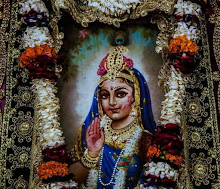
Foto: Kṛṣṇa a prostrar-se aos pés de Rādhā.
Existem 4 formas de alcançar Siddha Deha:
1 - Guru.
2 - Kṛṣṇa.
3 - Pela realização de cantar o Santo Nome.
4 - Parikalpya (cria, constrói, manufactura).
Onde os números 2, 3 e 4 são essencialmente o mesmo.
Por cantar o Santo Nome, que é o próprio Kṛṣṇa, o Sādhaka desenvolve desejos espirituais de serviço, e assim "cria, manufactura e constrói" (Parikalpya) na sua mente seu próprio Siddha Deha no qual medita.
Ou seja, o Sādhaka tem uma "revelação interna". Mas esta "revelação interna" não significa que aparece uma luz no céu e diz: "Seu Siddha-deha é este !!!"
Não. "Revelação interna" significa simplemente que desperta no Sādhaka o desejo de servir numa determinada Rasa.
O Sādhaka pondera: "Por cantar o Santo Nome e ver a doçura das Deidades sinto-me inclinado a servir eternamente nesta Rasa, com esta roupa, neste local de residência no Dhāma, com esta idade eterna, de ter este serviço eterno (fazer guirlandas), que este é meu grupo, etc. Os 11 ítens do Ekādaśa-bhāva."
Esta é a revelação interna. Não é nenhuma luz que surge no céu !!!
====================
Śrīla Kṛṣṇadāsa Kavirāja Gosvāmī no seu comentário Sāraṅga Raṅgadā-ṭīkā do Kṛṣṇa Karṇāmṛta (2), diz:
rāgānugā mārge anutpanna rati sādhaka bhaktair api svepsita siddha dehaṁ manasi parikalpya
"No caminho de Rāgānugā mesmo um Sādhaka Bhakta que não tenha Rati pode pensar e meditar no seu próprio Siddha Deha criado e almejado."
Então, Śrīla Kṛṣṇadāsa Kavirāja Gosvāmī continua:
jāta ratīnāṁ tu svayam eva tad deha sphūrteḥ
"Então quando Rati surgir, este corpo será automaticamente revelado."
Aqui a palavra Parikalpya é extremamente importante. Parikalpya significa o Siddha Deha construído, manufacturado, criado pelo próprio Sādhaka na sua mente.
E assim o Sādhaka pensa e medita nos 11 (Ekādaśa) aspectos do seu Siddha Deha.
====================
O livro Śrī Gaura-Govindārcana-Smaraṇa-Paddhati de Śrīpāda Dhyānacandra Gosvāmī mostra como fazê-lo.
====================
O número 1 refere-se a Siddha-praṇālī onde o Guru informa o discípulo do seu (do Guru) Svarūpa e o Svarūpa do discípulo.
Nos Parivāras isto ocorre quando um praticante fixo mostra interesse e se aproxima do Guru.
Na Iskcon e Gauḍīya Maṭha não é uma informação, mas uma confirmação.
Śrīla Bhaktisiddhānta Sarasvatī Ṭhākura confirmou o Mañjarī Siddha-praṇālī a 13 discípulos de acordo com a biografia Śrī Bhaktisiddhānta Vaibhava.
Siddha-praṇālī é um processo autêntico, como podemos ver, dado nos Parivāras, e na Iskcon e Gauḍīya Maṭha não é dado, mas confirmado.
Siddha Pranali formal não existe na Iskcon. Mas deveria existir pelo menos uma confirmação com o Guru (Diksa ou Siksa).
Os dois processos são autorizados e levam ao sucesso. Há vários exemplos nos Sastras de praticantes que meditavam no seu Siddha Deha sem ter recebido Siddha Pranali formal. É tudo uma questão de tradição dependendo do Parampara. Há aqueles que dão e há aqueles que não dão. Ambos alcançam a perfeição e podem meditar no seu Siddha Deha. Com Siddha Pranali ou sem Siddha Pranali.
Siddha Pranali é como uma formalidade. É bonita. Se alguém recebe, ótimo. Mas não é essencial para meditar no Siddha Deha.
Enquanto que em alguns Parivāras o Guru informa acerca do Mañjarī Svarūpa sem consultar o discípulo, noutros Parivāras o Guru e discípulo actuam em conjunto para estabelecer o Mañjarī Svarūpa, ou seja, o Guru averigua as preferências do discípulo.
====================
"Se as preferências de alguém forem diferentes, o Guru fará mudanças. Se por outro lado o discípulo não gostar, ele deverá dizer abertamente ao seu mestre espiritual o que ele preferiria. O Guru considerará o assunto e lhe dará outra identidade, e se o discípulo gosta, revela também a sua.”
(Hari-nāma Cintāmaṇi, 15.72-73)
====================
"Quando o mestre espiritual está a verificar as inclinações pessoais puras do aspirante, o aspirante também deve ajudar o mestre espiritual, falando o que pensa sobre suas próprias preferências. Enquanto ele não tiver estabelecido claramente as inclinações do discípulo, as instruções do Guru não serão acertadas. As inclinações que foram moldadas pelas ações meritórias de uma pessoa, tanto nesta como em vidas anteriores, são chamadas de Ruci ou gosto. Esta inclinação específica é parte integrante da alma. Caso uma pessoa não tenha uma inclinação natural para Śṛṅgāra-rasa, mas por servidão ou amizade, então ele deve ser instruído adequadamente; caso contrário, haverá consequências indesejáveis."
(Hari-nāma Cintāmaṇi, Notas de Śrīla Bhaktivinoda Ṭhākura para 15.72-73)
====================
De salientar que na Iskcon o sistema de Siddha-praṇālī não será instituído devido a que Śrīla Prabhupāda criou um movimento mundial e internacional que abrange devotos de diferentes humores (Rasas).
No entanto, os devotos da Iskcon podem e devem executar serviço interno com o Siddha Deha como explicado no Néctar da Devoção. Porém é uma prática particular, pessoal e reservada. E a associação, quando tratar deste tema, feita com devotos no mesmo humor.
Na Iskcon, o processo de executar serviço interno com o Siddha Deha é de Parikalpya, ou seja, o praticante poderá ele mesmo criar (Parikalpya) o Siddha Deha na sua mente como vimos nos números 2, 3 e 4 acima.
====================
"Hamsadutta: Então Prabhupada, um devoto neófito, ele pode pensar que poderia ser muito bom ser um amigo de Krsna, mas ele poderá realmente ser uma folha de grama e ele estará totalmente satisfeito quando chegar a este estágio?
Prabhupada: Não. Se ele pensa assim, então ele (o devoto neófito) deve cultivar este conhecimento desta forma. Sim. Isto é descrito no Néctar da Devoção e Ensinamentos do Senhor Caitanya.
Hamsadutta: Mas esta pode não ser a sua posição actual. Pode ser uma outra?
Prabhupada: Não. Mas quando, no momento do serviço devocional (Sadhana Bhakti), se tal ímpeto vem, isso significa que ele tem esta relação. E ele deve desenvolvê-la. Isto é tudo. Isto significa que a relação real com Krsna está a surgir gradualmente. Está sendo desenvolvida. Então, é preciso desenvolvê-la, seguindo os passos dos amigos de Krsna em Vrindavana. Isto é descrito aqui."
(Palestra Srimad-Bhagavatam 6.3.16-17, Gorakhpur, 18 de fevereiro de 1971)
====================
Uma carta de Śrīla Bhaktisiddhānta Sarasvatī Gosvāmī Mahārāja:
"Verifiquei sua carta datada do dia 24. O Aṣṭa-kālīya-līlā sobre o qual você ouviu falar dos Vaiṣṇavas em Vṛndāvana deve ser altamente considerado, sem dúvida.
Mas a forma como estes passatempos são concebidos no estado contaminado é totalmente corrupta.
Alguns indivíduos afortunados são capazes de saber essas coisas depois de cantar por um longo período (15 a 20 anos), pois esta é a identidade do verdadeiro eu.
Mas isto só pode ser conhecido depois que alguém está livre de contaminações mentais. Com o despertar desta identidade espiritual, a pessoa automaticamente tem uma cognição constante de sua forma espiritual.
Aqueles que dizem que podem ensinar ou revelar esta identidade estão praticando uma espécie de engano; isto não pode ser feito.
Por outro lado, se um devoto receber alguma inspiração depois de cantar sinceramente por um longo tempo, ele deve ir ao Sad-guru ou aos devotos avançados e pedir que isto seja confirmado e purificado por eles.
A identidade espiritual tem onze aspectos (Ekādaśa-bhāva). Há muitos casos de Gurus inescrupulosos que alimentam artificialmente essas designações em praticantes não qualificados, mas não podemos chamar isto de marca da perfeição espiritual.
Aqueles que alcançaram a perfeição de fixação em sua identidade espiritual (Svarūpa-siddhi) alcançaram tal realização através da revelação interna e o único envolvimento do mestre espiritual nesses assuntos é ajudar no avanço adicional de um discípulo.
À medida que um praticante progride em direcção à perfeição espiritual, todas estas coisas são reveladas naturalmente no coração que busca sinceramente o serviço."
====================
Śrī Bilvamaṅgala Ṭhākura, autor do Kṛṣṇa Karṇāmṛta, não recebeu Siddha-praṇālī e mesmo assim meditava em seu Siddha Deha como confirmado por Śrīla Kṛṣṇadāsa Kavirāja Gosvāmī.
====================
Especificamente na Iskcon há três tipos de devoto(a)s. E aqui falamos de devoto(a)s com 40, 50 anos de prática devocional:
1 - Aqueles que simplesmente ignoram Rasa Tattva (Raganuga Bhakti) e esperam unicamente Krpa Siddhi.
2 - Aqueles um pouco mais abertos ao tópico que consideram a importância de transitar de Vaidhi para Raganuga na fase de Sadhana, mas ainda com alguma reserva em meditar em todos os aspectos do Siddha Deha. Só cultivam uma Rasa específica mas sem Ekadasa Bhava.
3 - Aqueles ainda um pouco mais abertos ao tópico que consideram a importância de transitar de Vaidhi para Raganuga na fase de Sadhana e cultivam e meditam nos 11 aspectos (Ekadasa Bhava) do Siddha Deha.
Todos os três têm amparo nos Sastras.
Mas devemos salientar que aqueles que meditam nos 11 aspectos (Ekadasa Bhava) do Siddha Deha seguem a parte mais bonita e mais completa (serviço interno e serviço externo) do processo Vaisnava Gaudiya.
====================
<algo que você obtém na iniciação>
Existem duas maneiras de fazer isto.
Temos duas abordagens relativas ao papel do Guru em revelar a forma particular do Siddha Rūpa do iniciado.
1 - Uma abordagem afirma que o Guru, por meio de sua visão meditativa, tem a capacidade de ver qual forma na Līlā eterna o discípulo possui.
No momento da iniciação, o Guru revela ao iniciado a forma detalhada de seu Siddha Rūpa, conforme visto no mundo da Līlā por meditadores aperfeiçoados.
2 - Na segunda abordagem guru e discípulo trabalham juntos para estabelecer Siddha deha.
Veja Hari-nāma Cintāmaṇi, 15.72-73 acima.
====================
"A verdadeira questão é se o Sādhaka tem alguma contribuição sobre o assunto. Acho que a resposta é claramente sim. Isto é o que Bhaktivinoda Ṭhākura diz no Hari Nāma Cintāmaṇi, e este também era o sistema de Lalita Prasāda Ṭhākura. Ele ficava mais satisfeito com um discípulo que sabia o que queria por alguém que aceitava passivamente tudo o que lhe era dado."
(Bhaktivinoda Parivara)
====================
O teu caso é o número 1. Tu recebeste do teu Guru toda a informação do teu Siddha‑deha. Recebeste um papel com toda esta informação. Este papel tem o nome de Dīkṣā Patra.
Não participaste em nada. O teu Guru deu‑te toda a informação do teu Siddha‑deha e tu aceitaste.
====================
No meu caso, é diferente. São os números 2, 3, 4. Sou eu, como Sādhaka que estabeleço todos os itens do meu Siddha‑deha. Eu escolho meu nome, eu escolho minha roupa, eu escolho minha idade, eu escolho meu serviço, etc.
Mas depois confirmo tudo isso com o Guru. Eu confirmei tudo isso com o Guru.
São dois caminhos diferentes, mas que vão dar ao mesmo. E ambos precisam da participação do Guru.
Mas é preciso salientar em relação ao número 1 o seguinte:
Nesta aproximação, o Guru “dá” o Siddha‑deha e pareceria que o discípulo não participa em nada.
Mas na verdade, nesta aproximação, o Guru não “dá” o Siddha‑deha. Em meditação, o Guru só visualiza a forma eterna do discípulo e informa o mesmo sobre isso.
E portanto, quando o Guru nesta aproximação diz por exemplo: “Teu Sāri é azul”, não é o Guru que está a escolher esta cor. Ele só visualizou esta cor que na verdade é escolha do Sādhaka.
Assim o Sādhaka fica completamente satisfeito com a informação do Guru e pensa: “Todos estes detalhes do Siddha‑deha que meu Guru informou, são na verdade desejados por mim.”
====================
O caminho em que o Guru "dá" ou fornece todos os detalhes, às vezes é criticado como se o Guru impusesse alguma coisa.
Mas na verdade o Guru não impõe. Todas aquelas pessoas que se aproximam de um Guru conhecido de algum Parivāra, já sabem que este mesmo Guru segue Mādhurya Mañjarī Bhāva. O praticante, aspirante, Sādhaka sabe disso. O Guru não impõe isso. É uma escolha do Sādhaka.
Alguns poderão argumentar: "Ok, não impõe a Rasa, mas impõe os detalhes do Siddha-deha."
Mesmo isso não é imposto. O Sādhaka, o discípulo escolhe o que o Guru escolhe e fica satisfeito. "Os detalhes do Siddha-deha que meu Guru escolher para mim está bom."
E portanto, em última análise é escolha do Sādhaka e não imposição do Guru.
Quando um Guru medita e visualiza o Siddha-deha do discípulo e depois informa o mesmo, está simplesmente antecipando como o próprio Sādhaka desejaria servir. Não há imposição.
Nós nunca estivemos no mundo espiritual. Porém o nosso Siddha-deha é eterno. Antes de nós assumirmos, ele sempre existiu. O nosso Siddha-deha já está a atuar no mundo espiritual mesmo antes de assumirmos o mesmo num eterno agora.
====================
No Bṛhad-bhāgavatāmṛta, de Sanātana Gosvāmī, quando Nārada Muni instrui Gopa-kumāra, aprendemos que meditar sobre o próprio siddha-deha durante o sādhana também se aplica aos sādhakas que desejam entrar em Vaikuṇṭha:
"Na sua meditação interna, o sādhaka serve os pés de lótus de Śrī Kṛṣṇa num rasa específica, com uma forma, veste e assim por diante que sejam adequados ao seu serviço.
Ao atingir a perfeição no final da sua vida, entra em Vaikuṇṭha. Nesse momento, o seu coração é atraído por aquele rasa anterior no qual, enquanto estava no estágio de sādhaka, adorava o Senhor, e aceita uma veste e forma idênticas, sabendo que são queridas a Śrī Bhagavān."
(BB 2.4.145-146)
Do comentário de Sanātana Gosvāmī:
"Quem chega a Vaikuṇṭha realiza o mesmo serviço aos pés de lótus de Kṛṣṇa pelo qual desenvolveu o gosto durante sua vida material, e realiza esse serviço em todos os pormenores, com as suas vestes, forma e assim por diante, pois cada estado de devoção é caro à Personalidade de Deus e cada um proporciona prazer ao devoto nele absorto."
Photo: Kṛṣṇa bows to Rādhā.
There are four ways to attain Siddha Deha:
1 - Guru.
2 - Kṛṣṇa.
3 - By chanting the Holy Name.
4 - Parikalpya (creates, builds, manufactures).
Where the numbers 2, 3, and 4 are essentially the same.
By chanting the Holy Name, which is Kṛṣṇa Himself, the Sādhaka develops spiritual desires for service, and thus "creates, manufactures, and builds" (Parikalpya) in his/her mind his/her own Siddha Deha on which he/she meditates.
That is, the Sādhaka has an "inner revelation." But this "inner revelation" does not mean that a light appears in the sky and says, "Your Siddha-deha is this !!!"
No. "Inner revelation" simply means that it awakens in the Sādhaka the desire to serve in a particular Rasa.
The Sadhaka ponders: "By chanting the Holy Name and seeing the sweetness of the Deities, I feel inclined to serve eternally in this Rasa, with this clothing, in this place of residence in Dhāma, with this eternal age, to have this eternal service (making garlands), that this is my group, etc. The 11 items of Ekādaśa-bhāva."
This is the inner revelation. It is not some light appearing in the sky !!!
====================
Śrīla Kṛṣṇadāsa Kavirāja Gosvāmī in his commentary Sāraṅga Raṅgadā-ṭīkā on the Kṛṣṇa Karṇāmṛta (2), says:
rāgānugā mārge anutpanna rati sādhaka bhaktair api svepsita siddha dehaṁ manasi parikalpya
"On the path of Rāgānugā even a Sādhaka Bhakta who does not have Rati can think and meditate on his/her own created and desired Siddha Deha."
Then, Śrīla Kṛṣṇadāsa Kavirāja Gosvāmī continues:
jāta ratīnāṁ tu svayam eva tad deha sphūrteḥ
"Then when Rati arises, this body will be automatically revealed."
Here the word Parikalpya is extremely important. Parikalpya means the Siddha Deha constructed, manufactured, created by the Sādhaka himself/herself in his/her mind.
And so the Sādhaka thinks and meditates on the 11 (Ekādaśa) aspects of his/her Siddha Deha.
====================
The book Śrī Gaura-Govindārcana-Smaraṇa-Paddhati by Śrīpāda Dhyānacandra Gosvāmī shows how to do this.
====================
Number 1 refers to Siddha-praṇālī, where the Guru informs the disciple of his/her (the Guru's) Svarūpa and the disciple's Svarūpa.
In Parivāras, this occurs when a fixed practitioner shows interest and approaches the Guru.
In Iskcon and Gauḍīya Maṭha, it is not information but a confirmation.
Śrīla Bhaktisiddhānta Sarasvatī Ṭhākura confirmed the Mañjarī Siddha-deha for 13 disciples according to the biography Śrī Bhaktisiddhānta Vaibhava.
Siddha-pranali is an authentic process, as we can see, given in Parivāras, and in Iskcon and Gauḍīya Maṭha it is not given, but confirmed.
Formal Siddha Pranali does not exist in Iskcon. But there should be at least a confirmation with the Guru (Diksa or Siksa).
Both processes are authorized and lead to success. There are several examples in the Sastras of practitioners who meditated on their Siddha Deha without having received formal Siddha Pranali. It's all a matter of tradition depending on the Parampara. There are those who give it and there are those who don't. Both achieve perfection and can meditate on their Siddha Deha. With Siddha Pranali or without Siddha Pranali.
Siddha Pranali is like a formality. It's beautiful. If someone receives it, great. But it's not essential to meditate on Siddha Deha.
While in some Parivāras the Guru informs about the Mañjarī Svarūpa without consulting the disciple, in other Parivāras the Guru and disciple work together to establish the Mañjarī Svarūpa, that is, the Guru ascertains the disciple's preferences.
====================
"If someone's preferences are different, the Guru will make changes. If, on the other hand, the disciple doesn't like it, he/she should openly tell his/her spiritual master what he/she would prefer. The Guru will consider the matter and give it another identity, and if the disciple likes it, he/she will also reveal his/her."
(Hari-nāma Cintāmaṇi, 15.72-73)
====================
"When the spiritual master is verifying the pure personal inclinations of the aspirant, the aspirant should also assist the spiritual master by speaking about his/her own preferences. Until he/she has clearly established the disciple's inclinations, the Guru's instructions will not be accurate. The inclinations that have been shaped by a person's meritorious actions, both in this life and in previous lives, are called Ruci or inclination. This specific inclination is an integral part of the soul. If a person does not have a natural inclination towards Śṛṅgāra-rasa, but towards servitude or friendship, then he/she should be properly instructed; otherwise, there will be undesirable consequences."
(Hari-nāma Cintāmaṇi, Notes by Śrīla Bhaktivinoda Ṭhākura for 15.72-73)
====================
It is worth noting that the Siddha-praṇālī system will not be instituted in Iskcon because Śrīla Prabhupāda created a worldwide and international movement encompassing devotees of different moods (Rasas).
However, Iskcon devotees can and should perform internal service with Siddha Deha as explained in the Nectar of Devotion. However, it is a private, personal, and reserved practice. And the association, when dealing with this theme, performed with devotees in the same mood.
In Iskcon, the process of performing internal service with the Siddha Deha is called Parikalpya, meaning the practitioner can create (Parikalpya) the Siddha Deha in his/her own mind, as we saw in numbers 2, 3, and 4 above.
====================
"Hamsadutta: So Prabhupada, a neophyte devotee, he might think that it would be very good to be a friend of Krsna, but he could really be a blade of grass and he will be completely satisfied when he reaches that stage?
Prabhupada: No. If he thinks like that, then he (the neophyte devotee) should cultivate that knowledge in that way. Yes. That is described in the Nectar of Devotion and Teachings of Lord Caitanya.
Hamsadutta: But this may not be his current position. Could it be another one?
Prabhupada: No. But when, at the moment of devotional service (Sadhana Bhakti), if such an impulse comes, it means that he has that relationship. And he should develop it. That's all. It means that the real relationship with Krsna is gradually arising. It is being developed. So, it needs to be developed, following in the footsteps of Krsna's friends in Vrndavana. This is described here.
(Srimad-Bhagavatam Lecture 6.3.16-17, Gorakhpur, February 18, 1971)
====================
A letter from Śrīla Bhaktisiddhānta Sarasvatī Gosvāmī Mahārāja:
"I have checked your letter dated the 24th. The Aṣṭa-kālīya-līlā about which you heard from the Vaiṣṇavas in Vṛndāvana should undoubtedly be highly regarded.
But the way these pastimes are conceived in the contaminated state is totally corrupt.
Some fortunate individuals are able to know these things after chanting for a long period (15 to 20 years), for this is the identity of the true self.
But this can only be known after one is free from mental contamination. With the awakening of this spiritual identity, a person automatically has a constant awareness of his/her spiritual form.
Those who claim they can teach or reveal this identity are practicing a kind of deception; this cannot be done.
On the other hand, if a devotee receives any inspiration after sincerely chanting for a long time, they should go to the Sad-guru or advanced devotees and ask them to confirm and purify it.
The spiritual identity has eleven aspects (Ekādaśa-bhāva). There are many instances of unscrupulous Gurus artificially instilling these designations in unqualified practitioners, but we cannot call this a mark of spiritual perfection.
Those who have attained the perfection of fixation on their spiritual identity (Svarūpa-siddhi) have achieved such realization through inner revelation, and the only involvement of the spiritual master in these matters is to assist in the further advancement of a disciple.
As a practitioner progresses toward spiritual perfection, all these things are naturally revealed in the heart that sincerely seeks service."
====================
Śrī Bilvamaṅgala Ṭhākura, author of the Kṛṣṇa Karṇāmṛta, did not receive Siddha-praṇālī and yet meditated on his Siddha Deha, as confirmed by Śrīla Kṛṣṇadāsa Kavirāja Gosvāmī.
====================
Specifically in Iskcon there are three types of devotees. And here we are talking about devotees with 40, 50 years of devotional practice:
1 - Those who simply ignore Rasa Tattva (Raganuga Bhakti) and expect only Krpa Siddhi.
2 - Those who are somewhat more open to the topic and consider the importance of transitioning from Vaidhi to Raganuga in the Sadhana phase, but still have some reservations about meditating on all aspects of Siddha Deha. They only cultivate a specific Rasa, but without Ekadasa Bhava.
3 - Those who are even somewhat more open to the topic and consider the importance of transitioning from Vaidhi to Raganuga in the Sadhana phase and cultivate and meditate on the 11 aspects (Ekadasa Bhava) of Siddha Deha.
All three are supported by the Sastras.
But we must emphasize that those who meditate on the 11 aspects (Ekadasa Bhava) of Siddha Deha follow the most beautiful and complete part (internal and external service) of the Gaudiya Vaisnava process.
====================
<something you gain in initiation>
There are two ways to do this.
We have two approaches regarding the Guru's role in revealing the particular form of the initiate's Siddha Rūpa.
1 - One approach states that the Guru, through his/her meditative vision, has the ability to see what form the disciple possesses in the eternal Līlā.
At the moment of initiation, the Guru reveals to the initiate the detailed form of his/her Siddha Rūpa, as seen in the world of Līlā by perfected meditators.
2 - In the second approach, guru and disciple work together to establish Siddha deha.
See Hari-nāma Cintāmaṇi, 15.72-73 above.
====================
"The real question is whether Sādhaka has any contribution on the subject. I think the answer is clearly yes. This is what Bhaktivinoda Ṭhākura says in Hari Nāma Cintāmaṇi, and this was also the system of Lalita Prasāda Ṭhākura. He was more satisfied with a disciple who knew what he/she wanted than with someone who passively accepted everything given to him/her."
(Bhaktivinoda Parivara)
====================
Your case is number 1. You received all the information about your Siddha-deha from your Guru. You received a paper with all this information. This paper is called Dīkṣā Patra.
You didn't participate in anything. Your Guru gave you all the information about your Siddha-deha and you accepted it.
====================
In my case, it's different. It's numbers 2, 3, 4. I, as a Sādhaka, establish all the items of my Siddha-deha. I choose my name, I choose my clothes, I choose my age, I choose my service, etc.
But then I confirm all of this with the Guru. I confirmed all of this. with the Guru.
These are two different paths, but they lead to the same place. And both require the Guru's participation.
But it's important to emphasize the following regarding point number 1:
In this approach, the Guru "gives" the Siddha-deha, and it would seem that the disciple doesn't participate at all.
But in reality, in this approach, the Guru doesn't "give" the Siddha-deha. In meditation, the Guru only visualizes the disciple's eternal form and informs him/her about it.
Therefore, when the Guru in this approach says, for example, "Your Sāri is blue," it's not the Guru who is choosing this color. He only visualized this color, which is actually the Sādhaka's choice.
Thus, the Sādhaka is completely satisfied with the Guru's information and thinks: "All these details of the Siddha-deha that my Guru informed me of are actually what I desire."
====================
The path where the Guru "gives" or provides all the details is sometimes criticized as if the Guru were imposing something.
But in truth, the Guru does not impose. All those who approach a Guru from some Parivāra already know that this same Guru follows Mādhurya Mañjarī Bhāva. The practitioner, aspirant, Sādhaka knows this. The Guru does not impose this. It is a choice of the Sādhaka.
Some may argue: "Okay, he/she doesn't impose Rasa, but he/she imposes the details of the Siddha-deha."
Even that is not imposed. The Sādhaka, the disciple, chooses what the Guru chooses and is satisfied. "The details of the Siddha-deha that my Guru chooses for me are fine."
And therefore, ultimately it is the Sādhaka's choice and not the Guru's imposition.
When a Guru meditates and visualizes the disciple's Siddha-deha and then informs the same, he/she is simply anticipating how the Sādhaka himself/herself would wish to serve. There is no imposition.
We have never been in the spiritual world. However, our Siddha-deha is eternal. Before we assume it, it has always existed. Our Siddha-deha is already acting in the spiritual world even before we assume it in an eternal now.
====================
In Sanātana Gosvī's Bṛhad-bhāgavatāmṛta, when Nārada Muni instructs Gopa-kumāra, we learn that meditating on one's own siddha-deha during sādhana also applies to sādhakas who wish to enter Vaikuṇṭha:
"In his/her inner meditation, the sādhaka serves the lotus feet of Śrī Kṛṣṇa in a specific rasa, with a form, attire, and so forth that are suitable for his/her service.
Upon attaining perfection at the end of his/her life, he/she enters Vaikuṇṭha. At that moment, his/her heart is drawn to that previous rasa in which, while in the sādhaka stage, he/she worshipped the Lord, and he/she accepts an identical attire and form, knowing that they are dear to Śrī Bhagavān."
(BB 2.4.145-146)
From Sanātana Gosvāmī's commentary:
"One who attains Vaikuṇṭha performs the same service at the lotus feet of Kṛṣṇa for which he/she developed a taste during his/her material life, and performs this service in every detail, with his/her attire, form, and so forth, for every state of devotion is dear to the Personality of Godhead and each one gives pleasure to the devotee absorbed in it."