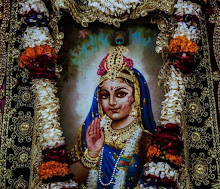
<Prabhupada definitivamente não enfatizou descobrirmos qual é a nossa Rasa com Krsna para além de nityo krsna das>
Como é que você pode dizer uma coisa dessas?
====================
"Hamsaduta: Então Śrīla Prabhupāda, um devoto neófito, pode pensar que seria muito bom ser amigo de Kṛṣṇa, mas será que ele pode realmente ser uma folha de erva e ficará completamente satisfeito quando chegar a esse estágio?
Śrīla Prabhupāda: Não. Mas quando, no momento do serviço devocional, surge tal ímpeto, significa que ele tem essa relação. E ele deve desenvolvê-la. Isso é tudo. Isto significa que a verdadeira relação com Kṛṣṇa está a emergir gradualmente. Está a ser desenvolvida. Por isso, é necessário desenvolvê-la, seguindo os passos dos amigos de Kṛṣṇa em Vṛndāvana. Isto é descrito aqui."
(Palestra Śrīmad-Bhāgavatam 6.3.16-17, Gorakhpur, 18 de fevereiro de 1971)
====================
"Vaidhī-bhakti, isto é aprendizagem. Bhakti verdadeira, Parā-bhakti, isto é Rāgānugā-bhakti. Esta Rāgānugā-bhakti, temos que atingir após passar por Vaidhī-bhakti. No mundo material, se não tentarmos fazer mais e mais progresso no serviço devocional, se estivermos simplesmente aderindo ao processo de regulação Śastrica e não tentando ir além dele..."
(Śrīla Prabhupāda - Palestra sobre SB 1.2.33 - Vṛndāvana, 12 de Novembro de 1972)
====================
Nestas citações, Srila Prabhupada deixa bem claro que devemos cultivar uma relação específica (Rasa) durante a prática devocional.
Vou deixar estas duas. Mas basta ler O Néctar da Devoção, Ensinamentos do Senhor Caitanya, O Néctar da Instrução e Caitanya Caritamrta.
Novamente. Como pode você dizer que Srila Prabhupada não quer que os seus seguidores cultivem uma Rasa específica durante o Sadhana?
É incrível ouvir isso de si. Um discípulo sénior de Srila Prabhupada.
Hare Krsna !!!
====================
Perfeitamente evidente, gritante, lúcido, simples, transparente e CRISTALINO !!!
Não há como ser mais claro do que isto.
seva sādhaka-rūpeṇa
siddha-rūpeṇa cātra hi
tad-bhāva-lipsunā kāryā
vraja-lokānusārataḥ
“No reino transcendental de Vraja [Vraja-dhāma], deve-se servir o Senhor Supremo, Śrī Kṛṣṇa, com um sentimento semelhante ao dos Seus associados, e deve-se ser colocado sob a orientação directa de um associado particular de Kṛṣṇa e deve-se seguir os seus passos. O devoto deve realizar serviço externamente como um devoto regulado, bem como internamente (com o Siddha-rupa) da sua posição auto-realizada. Deve realizar serviço devocional tanto externa como internamente. Este método é aplicável TANTO no estágio de Sādhana (práticas espirituais realizadas enquanto no estágio condicionado) COMO NO estágio de Sādhya, quando alguém é um Siddha-puruṣa, ou uma alma espiritualmente perfeita.”
(Śrīla A.C. Bhaktivedānta Svāmī Prabhupāda, Bhakti-rasāmṛta-sindhu 1.2.295)
Novamente:
“Este método é aplicável TANTO no estágio de Sādhana (práticas espirituais realizadas enquanto no estágio condicionado) COMO NO estágio de Sādhya.”
E Śrīla Prabhupāda conclui:
“Então, este movimento da consciência de Kṛṣṇa está a desenvolver-se gradualmente até o estágio de Rāgānugā-bhakti ou Parā-bhakti. Então a vida é bem-sucedida.”
...
Caso contrário, não é bem-sucedida !!!
====================
"Quando um devoto segue os passos dos devotos de Vṛndāvana, o seu serviço devocional é chamado Rāgānugā bhakti."
(Śrīla Prabhupāda - CC Madhya 22.149)
====================
"Em śānta-rasa, quando alguém aspira a ser como as vacas de Kṛṣṇa ou o bastão ou a flauta na mão de Kṛṣṇa, ou as flores à volta do pescoço de Kṛṣṇa. Em dāsya-rasa, alguém segue os passos de servos como Citraka, Patraka ou Raktaka. Na amigável sakhya-rasa, alguém pode tornar-se um amigo como Baladeva, Śrīdāmā ou Sudāmā. Em vātsalya-rasa, caracterizada pela afeição parental, alguém pode tornar-se como Nanda Mahārāja e Yaśodā, e em mādhurya-rasa, caracterizada pelo amor conjugal, alguém pode tornar-se como Śrīmatī Rādhārāṇī ou Suas amigas, como Lalitā e as Suas servas (mañjarīs) como Rūpa e Rati."
[Śrīla Prabhupāda - Śrī Upadeśāmṛta 8]
Certo?
====================
Outra coisa muito importante aqui nesta última citação é "quando alguém aspira", ASPIRAÇÃO. Isto significa que Rāgānugā-bhakti é realizada na fase de Sādhana quando se aspira a algo e não na fase perfeita.
Na fase perfeita não se aspira, porque já foi atingido. A aspiração está no estágio de Sādhana.
Raganuga Bhakti é descrito na secção de Sadhana Bhakti do Bhakti Rasamrta Sindhu.
Muito claro, certo?
====================
"Durante o período do aparecimento do Senhor Kṛṣṇa, a matança de Asuras ou descrentes como Kaṁsa e Jarāsandha foi feita por Viṣṇu, que estava na pessoa de Śrī Kṛṣṇa.
Tal aparente matança por parte do Senhor Śrī Kṛṣṇa ocorreu naturalmente e foi uma actividade incidental para Ele.
Mas o verdadeiro propósito da aparição do Senhor Kṛṣṇa era encenar uma representação dramática dos Seus passatempos transcendentais em Vrajabhūmi, exibindo assim o mais alto limite de suavidade transcendental nas trocas de amor recíproco entre a entidade viva e o Senhor Supremo.
Estas trocas recíprocas de doçuras são chamadas Rāga-bhakti, ou serviço devocional ao Senhor em êxtase transcendental.
O Senhor Śrī Kṛṣṇa quer fazer saber a todas as almas condicionadas que Ele é mais atraído por Rāga-bhakti do que por Vidhi-bhakti, ou serviço devocional sob regulamentos."
(Srīla Prabhupāda CC Adi 4,15-16)
====================
"Quando cantamos o Santo Nome, devemos pensar nas Lilas (passatempos) de Krsna - esta é a perfeição do canto."
(Srila Prabhupada)
=====================
nijābhīṣṭa kṛṣṇa-preṣṭha pācheta’ lāgiyā
nirantara seva kare antarmana haña
nija-abhīṣṭa — a própria escolha; kṛṣṇa-preṣṭha — o servo de Kṛṣṇa; pācheta’ lāgiyā — seguinte; nirantara — vinte e quatro horas por dia; sevā — serviço; kare — executa; antarmanā — dentro da mente; hañā — ser
“Na verdade, os habitantes de Vṛndāvana são muito acarinhados por Kṛṣṇa. Se alguém quiser envolver-se em serviço amoroso espontâneo (Rāgānugā Bhakti), deve seguir os habitantes de Vṛndāvana (de sua própria escolha) e ocupar-se constantemente em serviço devocional dentro da sua mente."
(Srila Prabhupada CC Madhya 22.159)
Aqui Nijābhīṣṭa é extremamente importante.
É o devoto, durante o período de Sādhana, que escolhe (Nijābhīṣṭa) o Kṛṣṇa Preṣṭha (servo de Kṛṣṇa) que deseja seguir.
====================
Śrī Caitanya-caritāmṛta Madhya-līlā 22.161:
dasa-sakhā-pitrādi-preyasīra gaṇa
raga-marge nija-nija-bhāvera gaṇana
"Existem muitos tipos de devotos — alguns são servos, outros são amigos, outros são pais e outros são amantes conjugais. Rāgānugā Bhaktas são místicos no caminho de Rāga (rāga-mārge) que escolhem a Rasa (nija-nija-bhāvera) pelo qual se relacionam com Kṛṣṇa."
====================
kṛṣṇaṁ smaran janaṁ cāsya
preṣṭhaṁ nija-samīhitam
tat-tat-kathā-rataś casau
kuryād vāsaṁ vraje sadā
"O devoto deve sempre pensar em Kṛṣṇa dentro de si mesmo e deve escolher um devoto muito querido que seja um servo de Kṛṣṇa em Vṛndāvana. Deve-se constantemente ocupar-se em tópicos sobre este servo e a sua relação amorosa com Kṛṣṇa, e deve-se viver em Vṛndāvana. Se alguém for fisicamente incapaz de ir para Vṛndāvana, deve viver mentalmente lá."
(Srila Prabhupada CC Madhya 22.160)
====================
"No início, é necessário prestar serviço estritamente de acordo com os princípios reguladores estabelecidos pelas escrituras reveladas e pelo mestre espiritual. Ao prestar serviço continuamente através do processo de vaidhī bhakti, a inclinação natural da pessoa é gradualmente despertada. A isto se chama atração espontânea, ou rāgānugā bhakti".
(Srila Prabhupada CC Madhya-lila 22.153 significado)
===================
<onde quer chegar com esta discussão?>
Estabelecer que Raganuga Bhakti significa serviço externo e interno numa Rasa específica, tal como definido no Néctar da Devoção.
E não apenas externo.
<Quer concentrar-se em saber se é um pavão ou um vaqueiro?>
A Rasa que cada praticante segue é algo privado e não deve ser mencionada aos outros.
Mas toda a ciência do serviço devocional e todos os seus detalhes, tal como explicados no Néctar da Devoção, devem ser estudados, e os devotos devem saber que, em algum momento, devem atravessar de Vaidhi para Raganuga. Srila Bhaktisiddhanta explica que isto deve ser feito após 15 a 20 anos de canto.
Temos devotos que cantam há quase 50 ANOS. Está na hora.
====================
Citou Srila Bhaktisiddhanta que diz que devemos reverenciar o caminho de Raga à distância. Isso mesmo. Nos primeiros anos. Mas depois de 15 a 20 anos de canto, Srila Bhaktisiddhanta explica que devemos seguir este caminho.
====================
O artigo:
"Todos estes dias não falamos de Līlā. Mas este é o nosso bem mais pessoal. Este é o nosso único Sādhya (o que deve ser alcançado).
Mas não se deve cometer o erro de pensar que Anartha-nivṛtti é o Prayojana (objectivo da vida). Alguém que pense assim nunca entrará em Artha-pravṛtti (serviço conjugal ao Casal Divino). Por esta razão começarei a falar de Aṣṭa-kālīya-līlā Smaraṇa.
Esta é uma realidade transcendental. Se não conhecermos este reino transcendental, então todos os nossos esforços poderão terminar em Nirviśeṣa-vāda. Não deixe que os seus dias passem simplesmente a tentar alcançar Anartha-nivṛtti.
Aqueles que cantam o Harināma há quinze ou vinte anos devem saber estas coisas. Os principiantes não precisam de ouvir estes tópicos ou serão mal compreendidos."
(Artigo de Śrīla Bhaktisiddhānta Sarasvatī Gosvāmī Mahārāja in The Gauḍīya 1934)
DE FACTO, Srila Bhaktisiddhanta guiou os seus discípulos maduros no momento certo e ajudou-os a refinar a sua meditação interior, bem como os elementos dos seus corpos internos.
====================
Assim, mais uma vez, peço-lhe humildemente, sendo um discípulo sénior de Sua Divina Graça Srila Prabhupada, que incentive os devotos mais jovens a fazerem serviço prático para a missão e que AO MESMO TEMPO saibam que em algum momento também terão de servir internamente numa Rasa específica.
Por favor. É a única coisa que lhe peço.
Muito obrigado. Hare Krsna !!!
==================
Está a dizer-me para "esquecer tudo isso"? Como? Apagando todas as instruções de Srila Prabhupada sobre o assunto dos livros?
A sua instrução para "esquecer tudo isto" é assustadora !!!
Está a assumir que, ao seguir Sadhana Bhakti Raganuga, o serviço externo será negligenciado.
Mas não é assim. É o oposto. O serviço prático externo aumenta. Distribuí 200.000 livros de Srila Prabhupada durante alguns anos e só deixei de o fazer porque tenho problemas de saúde.
Sadhana Bhakti Raganuga significa seguir o mestre espiritual externa e internamente.
Externamente, seguimos a missão de Srila Prabhupada distribuindo muitos livros, Prasadam, Harinamas, Ratha Yatras, Templos, etc. FAZER ALGO PRÁTICO PELA MISSÃO.
Internamente, seguimos o Guru num Rasa específica, ou Dasya, ou Vatsalya, ou Sakhya, ou Madhurya.
Afirmar que estamos a seguir externamente a missão do Guru e que isso em si é Raganuga Bhakti é incorrecto. É apenas metade da equação. 50%.
Sadhana Bhakti Raganuga significa seguir a missão do Guru externamente, e internamente num Rasa específica. Isto é 100%.
Este é um conceito absurdamente errado, propagado até por devotos seniores que, só por seguirem externamente a missão de Srila Prabhupada ou seguirem Sri Caitanya Mahaprabhu, que tem o humor de Radharani, isto já é Raganuga Bhakti.
Errado. Isto é apenas 50%.
E Srila Prabhupada confirma:
"Haṁsadūta: Suponha que alguém está satisfeito simplesmente por estar relacionado com o mestre espiritual.
Prabhupāda: Isso é um assunto de todos. Assunto de todos. Isto não é um gosto particular. Esse é o dever de todos os devotos."
(Palestra Śrīmad-Bhāgavatam 6.3.16-17, Gorakhpur, 18 de fevereiro de 1971)
====================
Cinco afirmações (mas há mais) que são completamente sem sentido e absurdas no que diz respeito a Rāgānugā Sādhana‑bhakti, mas que volta e meia voltamos a ouvir.
1 - "Rāgānugā‑bhakti só pode ser executada quando alguém é totalmente puro."
2 - "Uma voz do Céu se manifesta e diz que é o momento de iniciar Rāgānugā Sādhana‑bhakti."
3 - "Isto é tudo imaginação."
4 - "Isto é falta de humildade."
5 - "Seguir o corpo físico e somente o corpo físico de Śrīla Prabhupāda já é Rāgānugā‑bhakti de forma completa."
6 - "Com Raganuga Bhakti a pregação será negligenciada."
====================
Mas por incrível que pareça, há aqueles que afirmam tais absurdos.
=====================
1 - Nem Śrīla Prabhupāda e nem nenhum Ācārya afirma que Rāgānugā‑bhakti só pode ser executada quando alguém é totalmente puro.
O que todos afirmam é que é preciso ter alguma purificação. Mas "totalmente puro" é algo sem sentido. No Bhakti‑rasāmṛta‑sindhu, Rāgānugā‑bhakti está na secção de Sādhana‑bhakti.
O caminho progressivo de Bhakti é Sādhana‑bhakti (Sādhu‑saṅga, Bhajana‑kriyā, Anartha‑nivṛtti, Niṣṭhā, Ruci, Āsakti), depois vem Bhāva‑bhakti e depois vem Prema‑bhakti.
A fase de Anartha‑nivṛtti limpa alguns anarthas. Porém outros anarthas permanecem e assim em Niṣṭhā, Ruci, Āsakti o praticante ainda tem anarthas, mas começa a praticar Rāgānugā Sādhana‑bhakti.
Então "totalmente puro" é um grande disparate.
Anartha‑nivṛtti limpa de 50% a 75% dos anarthas. Depois em Niṣṭhā, Ruci e Āsakti continuam a haver anarthas.
Então o praticante pensa: "Como ainda tenho desejos materiais não posso começar Rāgānugā Sādhana‑bhakti."
Errado !!!
Isto é como um copo. Um copo vazio não está vazio. Tem ar. Um copo meio cheio, tem água e ar.
Da mesma forma o sādhaka tem 50%, 75% de desejos espirituais e 50%, 25% de desejos materiais na fase de Niṣṭhā, Ruci e Āsakti.
E então começa Rāgānugā Sādhana‑bhakti.
Ah, mas ainda tem desejos materiais !!! Sim, mas também tem desejos espirituais !!!
====================
2 - A segunda afirmação bizarra é de que "uma voz do Céu se manifesta e diz que é o momento de iniciar Rāgānugā Sādhana‑bhakti".
Isto acontece em Prema‑bhakti. Neste momento sim Rādhā‑Kṛṣṇa se manifestam, "uma voz do Céu". Mas não durante o sādhana.
Śrīla Viśvanātha Cakravartī no Mādhurya‑kādambinī explica como Kṛṣṇa se manifesta na fase de Prema. Isto não é na fase de Sādhana‑bhakti que é quando Rāgānugā‑bhakti é executada.
O início de Rāgānugā Sādhana‑bhakti não é através de "uma voz do Céu". É através da iniciativa do próprio praticante.
Como?
Através de uma auto‑análise. O praticante questiona‑se: "Tenho cantado o Mahā‑mantra e ouvido os passatempos por várias décadas. Por qual rasa eu sinto‑me mais atraído nos passatempos de Vṛndāvana?"
Não é nenhuma "voz do Céu" que desencadeia o início de Rāgānugā Sādhana‑bhakti. É iniciativa do próprio sādhaka, praticante.
Assim, o sādhaka, ao identificar a rasa que mais o atrai, começa a cultivá‑la ouvindo cada vez mais passatempos sobre esta rasa almejada. Não por desfrute pessoal. Mas é a rasa com a qual deseja servir. É desejo de serviço.
Aliás, se não for o sādhaka a tomar a iniciativa, isto não vai acontecer com "uma voz do Céu."
Isto é lobha, e assim começa o Rāgānugā Sādhana‑bhakti.
Assim é explicado por Śrīla Prabhupāda e todos os Ācāryas.
====================
3 - Vale a pena destacar outro conceito errado que frequentemente surge a propósito de Rāgānugā‑bhakti:
"Aqueles que procuram o caminho de Rāgānugā‑bhakti não são humildes porque querem forçar um relacionamento com Kṛṣṇa."
Um completo disparate, é exactamente o contrário.
Aqueles que trilham o caminho de Rāgānugā Sādhana‑bhakti estão humildemente a seguir a orientação de Śrīla Prabhupāda, de todos os Ācāryas e do próprio Kṛṣṇa.
É Kṛṣṇa que quer que escolhamos a forma como queremos nos relacionar com Ele.
Seguir este caminho de Rāgānugā Sādhana‑bhakti é uma prova de humildade.
===================
4 - Este é um dos grandes conceitos errados a respeito de Rāgānugā‑bhakti: que tudo é produto da "imaginação material".
Rāgānugā não inventa o objecto – segue o objecto eterno.
Definição de Rāgānugā por Śrī Jīva Gosvāmī e Śrī Viśvanātha: seguir a rāga dos habitantes eternos de Vraja.
O sādhaka medita numa līlā, uma forma, um bhāva que já existe em Vraja; ele/ela não cria uma nova. Ele/ela não inventa nada. Não imaginamos nada.
Portanto, não é fantasia, é participação numa realidade preexistente (tad‑bhāva‑icchā‑mayī).
A imaginação seria, por exemplo, se o praticante afirmasse que deseja tocar guitarra com Kṛṣṇa no mundo espiritual.
O sādhaka não inventa nada. Segue o padrão das līlās conforme descrito no śāstra.
===================
5 - Sobre seguir um habitante de Vṛndāvana, sendo este habitante Śrīla Prabhupāda.
Sim, mas a forma de Śrīla Prabhupāda em Goloka Vṛndāvana não é a de um homem idoso (sādhaka‑rūpa).
Rāgānugā‑bhakti significa seguir um associado eterno numa rasa específica. Não se trata de seguir o sādhaka‑rūpa (corpo físico) do Guru.
Portanto, quando Śrīla Prabhupāda afirma que devemos segui‑lo como habitante de Vṛndāvana, isso refere‑se à sua forma física.
O mesmo se aplica a toda a Paramparā.
Por exemplo, seguimos a forma física de Rūpa Gosvāmī e a forma interior de Rūpa‑mañjarī.
Ainda, diariamente, as mañjarīs fazem guirlandas (de diferentes variedades) de flores.
Isto é descrito em pormenor, por exemplo, no Rādhā‑Kṛṣṇa‑gaṇoddeśa‑dīpikā.
Este é um serviço eterno. Ele existe eternamente.
Assim, um sādhaka que se inclina para servir como mañjarī e se sente atraído por este serviço, medita da seguinte forma:
"Gostaria que o meu serviço eterno (sevā) ao Casal Divino fosse fazer guirlandas, como descrito no Rādhā‑Kṛṣṇa‑gaṇoddeśa‑dīpikā."
Portanto, o sādhaka não inventa nada. Não fantasia nada. Não imagina nada. Inclina‑se para um serviço que já existe, eternamente.
Então, o sādhaka aproxima‑se do Guru (śikṣā ou dīkṣā) e pede a confirmação deste serviço eterno. E, obviamente, o Guru irá confirmar e encorajá‑lo.
E, ao meditar sobre este serviço eterno (sevā) com a mente "material", esta mesma mente espiritualiza‑se (cid‑vṛtti).
Assim, externamente, seguimos a forma externa de Śrīla Prabhupāda como um habitante de Vṛndāvana, e internamente escolhemos um associado eterno para seguir, conforme instruído pelo próprio Śrīla Prabhupāda. Internamente, seguimos Patraka, ou Subala, ou Nanda e Yaśodā, ou Lalitā.
Śrīla Prabhupāda deixa isso bem claro:
"Haṁsadūta: Então, Śrīla Prabhupāda, um devoto neófito, pode pensar que seria muito bom ser amigo de Kṛṣṇa, mas ele pode realmente ser uma folha de erva e ficará completamente satisfeito quando atingir este estágio?
Śrīla Prabhupāda: Não. Mas quando, no momento do serviço devocional, surge tal ímpeto, significa que ele possui esta relação. E ele deve desenvolvê‑la. Mais nada. Isso significa que o verdadeiro relacionamento com Kṛṣṇa está a emergir gradualmente. Está a ser desenvolvido. Por isso, é necessário desenvolvê‑lo, seguindo os passos dos amigos de Kṛṣṇa em Vṛndāvana. Isso está descrito aqui.
Haṁsadūta: Suponha que alguém está satisfeito simplesmente por se relacionar com o Mestre Espiritual.
Prabhupāda: Isto é um assunto de todos. Assunto de todos. Não é uma questão de gosto particular. É o dever de todos os devotos."
(Palestra Śrīmad‑Bhāgavatam 6.3.16‑17, Gorakhpur, 18 de fevereiro de 1971)
Śrīla Prabhupāda deixa bem claro aqui que seguir o corpo físico do Guru não é Rāgānugā‑bhakti.
====================
6 - “Meus caros Senhores (Śrī Śrī Rādhā Kṛṣṇa)! De que serve construir centenas e milhares de templos pomposamente opulentos, adorar milhares e milhões de Deidades grandiosamente ornamentadas, distribuir incontáveis zilhões de livros, (mal)gerir milhões e biliões de dólares, encher biliões e triliões de barrigas e congregar uma sociedade de centenas de milhares de neófitos semiconscientes e briguentos, se ao menos uma alma no meio desta coleção não puder, em última análise, alcançar o supremo privilégio de servir os tesouros dos Seus pés de lótus enquanto desfrutam incessantemente das Vossas transcendentais nikunja-līlās no Vosso reino eternamente resplandecente de Vraja-dhāma?”
6 - “Meus caros Senhores (Śrī Śrī Rādhā Kṛṣṇa)! De que serve construir centenas e milhares de templos pomposamente opulentos, adorar milhares e milhões de Deidades grandiosamente ornamentadas, distribuir incontáveis zilhões de livros, (mal)gerir milhões e biliões de dólares, encher biliões e triliões de barrigas e congregar uma sociedade de centenas de milhares de neófitos semiconscientes e briguentos, se ao menos uma alma no meio desta coleção não puder, em última análise, alcançar o supremo privilégio de servir os tesouros dos Seus pés de lótus enquanto desfrutam incessantemente das Vossas transcendentais nikunja-līlās no Vosso reino eternamente resplandecente de Vraja-dhāma?”
— Aindra Dāsa, O Coração da Distribuição Transcendental de Livros
====================
Śrīpāda Siddha Nāmanandi Aindra Dāsa Prabhu não é contra a distribuição de livros, a distribuição de Prasādam e templos belos e maravilhosos.
Tudo isto é incrível !!!
Mas o que ele realça é que este maravilhoso serviço externo deve ser acompanhado pelo serviço interno (Rāgānugā Bhakti).
Bhakti significa servir com o corpo externo (Sādhaka Rūpa) e com o corpo interno (Siddha Rūpa).
Assim, o círculo fecha-se e completa-se.
A vida de Aindra Prabhu foi um exemplo vivo desta síntese: serviço externo incansável através de kīrtana 24 horas por dia e profunda absorção interna em rāgānugā-bhakti.
====================
Todos estes conceitos errados (e há mais) estão aqui claramente explicados. Não permitam que eles bloqueiem vosso progresso.
====================
====================
<Prabhupada definitely did not stress for us to discover what our Rasa with Krsna is beyond nityo Krsna das>
How can you say such a thing?
====================
"Hamsaduta: So Śrīla Prabhupāda, a neophyte devotee, he may think that it could be very good to be a friend of Kṛṣṇa, but he can really be a blade of grass and will be completely satisfied when he reaches this stage?
Śrīla Prabhupāda: No. But when, at the time of devotional service, if such an impetus comes, it means that he has this relationship. And he must develop it. That's all. This means that the real relationship with Kṛṣṇa is gradually emerging. It is being developed. Therefore, it is necessary to develop it, following in the footsteps of Kṛṣṇa's friends in Vṛndāvana. This is described here."
(Śrīmad-Bhāgavatam Lecture 6.3.16-17, Gorakhpur, February 18, 1971)
====================
"Vaidhī-bhakti, that is apprenticeship. Real bhakti, Parā-bhakti, that is Rāgānugā-bhakti. This Rāgānugā-bhakti, we have to attain after passing Vaidhī-bhakti. In the material world, if we don't try to make more and more progress in devotional service, if we are simply adhering to the Śastric regulation process and not trying to go beyond it..."
(Śrīla Prabhupāda - Lecture on SB 1.2.33 - Vṛndāvana, 12 November 1972)
====================
In these quotations, Srila Prabhupada makes it very clear that we should cultivate a specific relationship (Rasa) during devotional practice.
I'll leave these two. But just read Nectar of Devotion, Teachings of Lord Caitanya, Nectar of Instruction and Caitanya Caritamrta.
Again. How can you say Srila Prabhupada does not want his followers to cultivate a specific Rasa during Sadhana?
It's amazing to hear that from you. A Senior disciple of Srila Prabhupada.
Hare Krsna!!!
Perfectly evident, glaring, lucid, plain, transparent and CRYSTAL clear !!!
There is no way to be clearer than this.
sevā sādhaka-rūpeṇa
siddha-rūpeṇa cātra hi
tad-bhāva-lipsunā kāryā
vraja-lokānusārataḥ
“In the transcendental realm of Vraja [Vraja-dhāma] one should serve the Supreme Lord, Śrī Kṛṣṇa, with a feeling similar to that of His associates, and should be placed under the direct guidance of a particular associate of Kṛṣṇa and one should follow in his footsteps. The devotee must perform service externally as a regulated devotee as well as internally (with the Siddha-rupa) from his self-realized position. Thus, he must perform devotional service both externally and internally. This method is applicable BOTH to the stage of Sādhana (spiritual practices performed while in the conditioned stage) AS IN THE Sādhya stage, when one is a Siddha-puruṣa, or a spiritually perfect soul.”
(Śrīla A.C. Bhaktivedānta Svāmī Prabhupāda, Bhakti-rasāmṛta-sindhu 1.2.295)
Again:
“This method is applicable BOTH to the stage of Sādhana (spiritual practices performed while in the conditioned stage) AS IN THE Sādhya stage.”
And:
Śrīla Prabhupāda concludes:
“So this Kṛṣṇa consciousness movement is gradually developing up to the stage of Rāgānugā-bhakti or Parā-bhakti. Then life is successful.”
...
Otherwise, it is not successful !!!
====================
"When a devotee follows in the footsteps of the devotees of Vṛndāvana, his devotional service is called Rāgānugā bhakti."
(Śrīla Prabhupāda - CC Madhya 22.149)
====================
"In the śānta-rasa when one aspires to be like Kṛṣṇa’s cows or the stick or flute in the hand of Kṛṣṇa, or the flowers around Kṛṣṇa’s neck. In the dāsya-rasa one follows in the footsteps of servants like Citraka, Patraka or Raktaka. In the friendly sakhya-rasa one can become a friend like Baladeva, Śrīdāmā or Sudāmā. In the vātsalya-rasa, characterized by parental affection, one can become like Nanda Mahārāja and Yaśodā, and in the mādhurya-rasa, characterized by conjugal love, one can become like Śrīmatī Rādhārāṇī or Her lady friends such as Lalitā and Her serving maids (mañjarīs) like Rūpa and Rati. This is the essence of all instruction in the matter of devotional service."
[Śrīla Prabhupāda - Śrī Upadeśāmṛta 8]
Right?
Another very important thing here in this last quote is "when one aspires", ASPIRATION. This means that Rāgānugā-bhakti is performed in the Sādhana phase when aspiring to something and not in the perfect phase.
In the perfect phase one does not aspire, because it has already been achieved. Aspiration is in the stage of Sādhana.
Raganuga Bhakti is described in the Sadhana Bhakti section of Bhakti Rasamrta Sindhu.
Very clear, right?
"During the period of Lord Kṛṣṇa’s appearance, the killing of Asuras or nonbelievers such as Kaṁsa and Jarāsandha was done by Viṣṇu, who was within the person of Śrī Kṛṣṇa.
Such apparent killing by Lord Śrī Kṛṣṇa took place as a matter of course and was an incidental activity for Him.
But the real purpose of Lord Kṛṣṇa’s appearance was to stage a dramatic performance of His transcendental pastimes at Vrajabhūmi, thus exhibiting the highest limit of transcendental mellow in the exchanges of reciprocal love between the living entity and the Supreme Lord.
These reciprocal exchanges of mellows are called Rāga-bhakti, or devotional service to the Lord in transcendental rapture.
Lord Śrī Kṛṣṇa wants to make known to all the conditioned souls that He is more attracted by Rāga-bhakti than Vidhi-bhakti, or devotional service under scheduled regulations."
(Śrīla Prabhupāda CC Ādi 4.15-16)
====================
"When we chant the Holy Name we should think of Krsna's Lila (pastimes) - this is perfection of chanting."
(Srila Prabhupada)
=====================
nijābhīṣṭa kṛṣṇa-preṣṭha pācheta’ lāgiyā
nirantara sevā kare antarmanā hañā
nija-abhīṣṭa — one’s own choice; kṛṣṇa-preṣṭha — the servitor of Kṛṣṇa; pācheta’ lāgiyā — following; nirantara — twenty-four hours a day; sevā — service; kare — executes; antarmanā — within the mind; hañā — being
“Actually the inhabitants of Vṛndāvana are very dear to Kṛṣṇa. If one wants to engage in spontaneous loving service (Rāgānugā Bhakti), he must follow the inhabitants of Vṛndāvana (of one’s own choice) and constantly engage in devotional service within his mind."
(Srila Prabhupada CC Madhya 22.159)
Here Nijābhīṣṭa is extremely important.
It is the devotee, during the period of Sādhana, who choose (Nijābhīṣṭa) the Kṛṣṇa Preṣṭha (servant of Kṛṣṇa) who wants to follow.
====================
Śrī Caitanya-caritāmṛta Madhya-līlā 22.161:
dāsa-sakhā-pitrādi-preyasīra gaṇa
rāga-mārge nija-nija-bhāvera gaṇana
"There are many types of devotees—some are servants, some are friends, some are parents, and some are conjugal lovers. Rāgānugā Bhaktas are mystics on the path of Rāga (rāga-mārge) who choose the Rasa (nija-nija-bhāvera) by which they relate to Kṛṣṇa."
====================
kṛṣṇaṁ smaran janaṁ cāsya
preṣṭhaṁ nija-samīhitam
tat-tat-kathā-rataś cāsau
kuryād vāsaṁ vraje sadā
"The devotee should always think of Kṛṣṇa within himself and should choose a very dear devotee who is a servitor of Kṛṣṇa in Vṛndāvana. One should constantly engage in topics about that servitor and his loving relationship with Kṛṣṇa, and one should live in Vṛndāvana. If one is physically unable to go to Vṛndāvana, he should mentally live there."
(Srila Prabhupada CC Madhya 22.160)
====================
"In the beginning one has to render service strictly according to the regulative principles set forth by the revealed scriptures and spiritual master. By continuously rendering service through the process of vaidhī bhakti, one’s natural inclination is gradually awakened. That is called spontaneous attraction, or rāgānugā bhakti".
(Srila Prabhupada CC Madhya-lila 22.153 purport)
===================
<where are u going with this discussion.>
Establish that Raganuga Bhakti means external and internal service in a specific Rasa as defined in the Nectar of Devotion.
And not just external.
<Do u want to hone in on whether you’re a peacock or cowherd boy?>
The Rasa that each practitioner follows is something private and should not be mentioned to others.
But the whole science of devotional service and all its details as explained in the Nectar of Devotion should be studied, and devotees should know that at some point they must cross over from Vaidhi to Raganuga. Srila Bhaktisiddhanta explains that this should be done after 15 - 20 years of chanting.
We have devotees who have been chanting for almost 50 YEARS. It's time.
====================
You quoted Srila Bhaktisiddhanta who says that we should revere the path of Raga from a distance. That's correct. In the early years. But after 15 - 20 years of chanting, Srila Bhaktisiddhanta explains that we should follow this path.
====================
The article:
"All these days we have not spoken about Līlā. But this is our most personal asset. This is our only Sādhya (what must be achieved).
But one should not make the mistake of thinking that Anartha-nivṛtti is the Prayojana (goal of life). One thinking like this will never enter into Artha-pravṛtti (conjugal service of the Divine Couple). For this reason I will begin speaking about Aṣṭa-kālīya-līlā Smaraṇa.
This is transcendental reality. If we do not know of this transcendental realm, then all of our efforts may end in Nirviśeṣa-vāda. Do not let your days pass in simply trying for Anartha-nivṛtti.
Those who have chanted the Harināma for fifteen or twenty years should know such things. The beginners need not hear these topics or they will be misunderstood."
(Śrīla Bhaktisiddhānta Sarasvatī Gosvāmī Mahārāja article in The Gauḍīya 1934)
INDEED, Srila Bhaktisiddhanta guided his mature disciples at the right time and helped them to refine their inner meditation as well as the elements of their inner body.
====================
So again, I humbly request you, being a senior disciple of His Divine Grace Srila Prabhupada, to encourage the younger devotees to do practical service for the mission and AT THE SAME TIME know that at some point they will also have to serve internally in a specific Rasa.
Please. It is the only thing I ask of you.
Thank you very much. Hare Krsna !!!
==================
Are you telling me to "forget all this"? How? By deleting all of Srila Prabhupada's instructions on the subject from the books?
Your instruction to "forget all this" is scary !!!
You are assuming that by following Sadhana Bhakti Raganuga, external service will be neglected.
But it is not like that. It's the opposite. External practical service increases. I distributed 200,000 of Srila Prabhupada's books for a few years and I only stop doing so because I have health problems.
Sadhana Bhakti Raganuga means following the spiritual master externally and internally.
Externally we follow Srila Prabhupada's mission by distributing many books, Prasadam, Harinamas, Ratha Yatras, Temples, etc. DO SOMETHING PRACTICAL FOR THE MISSION.
Internally we follow the Guru in a specific Rasa, or Dasya, or Vatsalya, or Sakhya, or Madhurya.
To claim that we are externally following the Guru's mission and that this in itself is Raganuga Bhakti is incorrect. It's only half the equation. 50%.
Sadhana Bhakti Raganuga means following the Guru's mission externally, and internally in a specific Rasa. That's 100% follow.
This is an absurdly wrong concept propagated even by senior devotees that just by externally following Srila Prabhupada's mission or following Sri Caitanya Mahaprabhu Who has the mood of Radharani, that is already Raganuga Bhakti.
Wrong. That's only 50%.
And Srila Prabhupada confirms:
"Haṁsadūta: Suppose someone is satisfied simply being related with the spiritual master.
Prabhupāda: That is everyone's business. Everyone's business. That is not a particular taste. That is the duty of all devotees."
(Śrīmad-Bhāgavatam Lecture 6.3.16-17, Gorakhpur, February 18, 1971)
====================
====================
Five statements (but there are more) that are completely nonsensical and absurd regarding Rāgānugā Sādhana-bhakti, yet we hear them again and again.
1 - "Rāgānugā-bhakti can only be performed when one is completely pure."
2 - "A voice from Heaven manifests and says it's time to begin Rāgānugā Sādhana-bhakti."
3 - "This is all imagination."
4 - "This is a lack of humility."
5 - "Following the physical body and only the physical body of Śrīla Prabhupāda is already complete Rāgānugā-bhakti."
6 - "With Raganuga Bhakti, preaching will be neglected."
====================
But incredibly, there are those who assert such absurdities.
=====================
1 - Neither Śrīla Prabhupāda nor any Ācārya claims that Rāgānugā-bhakti can only be performed when one is completely pure.
What everyone claims is that some purification is necessary. But "totally pure" is meaningless. In Bhakti-rasāmṛta-sindhu, Rāgānugā-bhakti is in the Sādhana-bhakti section.
The progressive path of Bhakti is Sādhana-bhakti (Sādhu-saṅga, Bhajana-kriyā, Anartha-nivṛtti, Niṣṭhā, Ruci, Āsakti), then comes Bhāva-bhakti and then Prema-bhakti.
The Anartha-nivṛtti phase cleanses some anarthas. However, other anarthas remain, and so in Niṣṭhā, Ruci, Āsakti the practitioner still has anarthas, but begins to practice Rāgānugā Sādhana-bhakti.
Therefore, "totally pure" is utter nonsense.
Anartha-nivṛtti cleanses 50% to 75% of the anarthas. So, in Niṣṭhā, Ruci, and Āsakti, there are still anarthas.
Then the practitioner thinks: "Since I still have material desires, I cannot begin Rāgānugā Sādhana-bhakti."
Wrong !!!
It's like a cup. An empty cup isn't empty. It has air. A half-full cup has water and air.
Similarly, the sādhaka has 50%, 75% spiritual desires and 50%, 25% material desires in the Niṣṭhā, Ruci, and Āsakti phases.
And then Rāgānugā Sādhana-bhakti begins.
Ah, but I still have material desires !!! Yes, but you also have spiritual desires !!!
====================
2 - The second bizarre statement is that "a voice from Heaven manifests and says it's time to begin Rāgānugā Sādhana-bhakti."
This happens in Prema-bhakti. At this moment, yes, Rādhā-Kṛṣṇa manifests, "a voice from Heaven." But not during Sādhana.
Śrīla Viśvanātha Cakravartī in the Mādhurya-kādambinī explains how Kṛṣṇa manifests in the Prema phase. This is not in the Sādhana-bhakti phase, which is when Rāgānugā-bhakti is performed.
The beginning of Rāgānugā Sādhana-bhakti is not through "a voice from Heaven." It is through the practitioner's own initiative.
How?
Through self-analysis. The practitioner asks himself: "I have been chanting the Mahā-mantra and listening to the pastimes for several decades. Which rasa do I feel most drawn to in the Vṛndāvana pastimes?"
It is not any "voice from Heaven" that triggers the beginning of Rāgānugā Sādhana-bhakti. It is the initiative of the sādhaka, the practitioner, himself/herself.
Thus, the sādhaka, upon identifying the rasa that most attracts him/her, begins to cultivate it by listening more and more to pastimes about that desired rasa. Not for personal enjoyment. But it is the rasa with which you wish to serve. It is a desire for service.
Indeed, if the sādhaka does not take the initiative, this will not happen with "a voice from Heaven."
This is lobha, and thus begins Rāgānugā Sādhana-bhakti.
This is how it is explained by Śrīla Prabhupāda and all the Ācāryas.
====================
3 - It's worth highlighting another misconception that often arises regarding Rāgānugā-bhakti:
"Those who seek the path of Rāgānugā-bhakti are not humble because they want to force a relationship with Kṛṣṇa."
Complete nonsense and exactly the opposite.
Those who tread the path of Rāgānugā Sādhana-bhakti are humbly following the direction of Śrīla Prabhupāda and all the Ācāryas and Kṛṣṇa Himself.
It is Kṛṣṇa Who wants us to choose how we want to relate to Him.
Following this path of Rāgānugā Sādhana-bhakti is a testament to humility.
====================
4 - This is one of the great misconceptions regarding Rāgānugā-bhakti: that it is all a product of "material imagination."
Rāgānugā does not invent the object – it follows the eternal object.
Śrī Jīva Gosvāmī and Śrī Viśvanātha's definition of Rāgānugā: following the rāga of the eternal inhabitants of Vraja.
The sādhaka meditates on a līlā, a form, a bhāva that already exists in Vraja; he/she does not create a new one. He invents nothing. We don't imagine anything.
Therefore, it is not fantasy, it is participation in a pre-existing reality (tad-bhāva-icchā-mayī).
Imagination would be, for example, if the practitioner stated that he/she wanted to play the guitar with Kṛṣṇa in the spiritual world.
Sādhaka invents nothing. He follows the pattern of the līlās as described in the śāstra.
====================
5 - Regarding following an inhabitant of Vṛndāvana and this inhabitant being Śrīla Prabhupāda.
Yes, but Śrīla Prabhupāda's form in Goloka Vṛndāvana is not that of an elderly man (sādhaka-rūpa).
Rāgānugā-bhakti means following an eternal associate in a specific rasa. It is not following the sādhaka-rūpa (physical body) of the Guru.
So when Śrīla Prabhupāda states that we should follow him as an inhabitant of Vṛndāvana, that is in physical form.
It's the same with the entire Paramparā.
For example, we follow the physical form of Rūpa Gosvāmī and the inner form of Rūpa-mañjarī.
For example, daily, mañjarīs make garlands (different varieties) of flowers.
This is described in detail, for example, in the Rādhā-Kṛṣṇa-gaṇoddeśa-dīpikā.
This is an eternal service. It exists eternally.
So, some sādhaka who is inclined to serve as a mañjarī and feels drawn to doing this service, meditates like this:
"I would like my eternal service (sevā) to the Divine Couple to be making garlands as described in the Rādhā-Kṛṣṇa-gaṇoddeśa-dīpikā."
And therefore, the sādhaka invents nothing. Doesn't fantasize anything. Doesn't imagine anything. He is inclined towards a service that already exists, eternally.
Then the sādhaka approaches the Guru (śikṣā or dīkṣā) and asks for confirmation of this eternal service. And obviously the Guru will confirm and encourage it.
And by meditating on this eternal service (sevā) with the "material" mind, this same mind becomes spiritualized (cid-vṛtti).
So, externally we follow the external form of Śrīla Prabhupāda as an inhabitant of Vṛndāvana, and internally we choose an eternal associate to follow, as instructed by Śrīla Prabhupāda himself. Internally we follow either Patraka, or Subala, or Nanda and Yaśodā, or Lalitā.
Śrīla Prabhupāda makes it very clear:
"Haṁsadūta: So Śrīla Prabhupāda, a neophyte devotee, he may think that it could be very good to be a friend of Kṛṣṇa, but he can really be a blade of grass and will be completely satisfied when he reaches this stage?
Śrīla Prabhupāda: No. But when, at the time of devotional service, if such an impetus comes, it means that he has this relationship. And he must develop it. That's all. This means that the real relationship with Kṛṣṇa is gradually emerging. It is being developed. Therefore, it is necessary to develop it, following in the footsteps of Kṛṣṇa's friends in Vṛndāvana. This is described here.
Haṁsadūta: Suppose someone is satisfied simply being related with the spiritual master.
Prabhupāda: That is everyone's business. Everyone's business. That is not a particular taste. That is the duty of all devotees."
(Śrīmad-Bhāgavatam Lecture 6.3.16-17, Gorakhpur, February 18, 1971)
Śrīla Prabhupāda makes it very clear here that following the physical body of the Guru is not Rāgānugā-bhakti.
=====================
6 - “My dear Lordships (Śrī Śrī Rādhā Kṛṣṇa)! What is the use of constructing hundreds and thousands of pompously opulent temples, worshiping thousands and millions of grandiosely ornamented Deities, distributing umteenzillions of books, (mis)managing millions and billions of bucks, filling billions and trillions of bellies, and congregating a society of hundreds of thousands of semi-conscious squabbling neophytes, if even one soul amidst the menagerie could not ultimately achieve the supremely privileged maid-service of the treasures of Your lotus feet as You endlessly enjoy Your transcendental nikunja-līlās in Your eternally resplendent realm of Vraja-dhāma?”
6 - “My dear Lordships (Śrī Śrī Rādhā Kṛṣṇa)! What is the use of constructing hundreds and thousands of pompously opulent temples, worshiping thousands and millions of grandiosely ornamented Deities, distributing umteenzillions of books, (mis)managing millions and billions of bucks, filling billions and trillions of bellies, and congregating a society of hundreds of thousands of semi-conscious squabbling neophytes, if even one soul amidst the menagerie could not ultimately achieve the supremely privileged maid-service of the treasures of Your lotus feet as You endlessly enjoy Your transcendental nikunja-līlās in Your eternally resplendent realm of Vraja-dhāma?”
— Aindra Dāsa, The Heart of Transcendental Book Distribution
====================
Śrīpāda Siddha Nāmanandi Aindra Dāsa Prabhu is not against the distribution of books, the distribution of Prasādam, and beautiful and wonderful temples.
All of that is incredible !!!
But what he emphasizes is that this wonderful external service must be accompanied by internal service (Rāgānugā Bhakti).
Bhakti means serving with the external body (Sādhaka Rūpa) and with the internal body (Siddha Rūpa).
Thus the circle closes and becomes complete.
Aindra Prabhu’s life was a living example of this synthesis: tireless external service through 24-hour kīrtana, and deep internal absorption in rāgānugā-bhakti.
=====================
All these misconceptions (and there are more) are clearly explained here. Don't let them block your progress.
=====================